I apologize for the recent silence on this blog, but I have an excuse. No, the dog didn't eat my blogposts; no, I didn't fall into the house in House of Leaves (though I kinda want to); no, the internet was not taken over by Moon People from the future and their immortal writer/savior J. Ari Hilliard (if you don't know what I'm talking about, you should probably watch Lunopolis, and then let me take you out to dinner as consolation). The reason is this, simply:
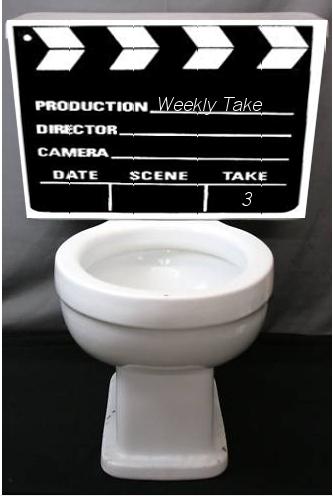
I have started, along with cohorts John Dwyer and Charlie Truong, a movie/book/video game review site. It's called The Weekly Take*, and you can follow us on twitter @theweeklytake. Every week the three of us do expectations (a quick write-up of what each of us hopes to get out of the film before viewing it), written reviews (obviously), and a podcast or "Premium Take" of an agreed-upon movie. We've already reviewed The Girl with the Dragon Tattoo; Tinker, Tailor, Soldier, Spy; Red Tails; The Grey; Chronicle; and The Descendants. Follow the links to listen to the podcasts. We also write expectations and reviews for films not slated for Premium Takes.
The Weekly Take's main focus is cinema and cinema-related content, but that isn't all we do. We also plan on reviewing books (look for Osama by Lavie Tidhar and Wonderstruck by Brian Selznick in the coming days), video games, and music.
Having said that, most of the content of this blog, The Spiral, has been book reviews and thoughts on writing and music; however, content of that nature will now be moving to The Weekly Take - and I certainly hope you "take," ahem, the leap with me to the new site. Therefore, The Spiral will remain active for only a little while longer. I do plan on maintaining a personal blog and am in the process of setting it up, the details of which are foggy as yet, but when it is ready, expect a final blogpost here with a link to the personal blog.
In the meantime, I invite you to follow (and, if you so wish, subscribe to) The Weekly Take, and hope you enjoy reading and listening to our reviews as much as we've enjoyed writing and recording them. See you out there!
*Yes, our logo is a toilet with a movie clapper. So what. We like potty jokes.
Showing posts with label book reviews. Show all posts
Monday, February 20, 2012
Friday, January 6, 2012
The Thread: Blood Work by Holly Tucker
This will be the thread I continue to post on while reading Blood Work: A Tale of Medicine and Murder in the Scientific Revolution by Holly Tucker. If any reader feels so inclined, you may of course post your thoughts about the book in the comments section below.
But Blood Work is more than blood. It is also an account of how we got to those first transfusions, the steps and missteps, and how blood transfusions were banned for two hundred years thereafter. The chapter on the Great Plague of London in 1665-6 and of the London Fire were particularly horrifying and captivating.
In part, Blood Work is fascinating because Tucker's prose doesn't read like a stuffy historical narrative; instead, I am reminded of magical realists like Gabriel Garcia Marquez. She doesn't shy away from writing grotesquely vivid descriptions of the transfusions and, accompanied by the illustrations of the experiment tables and tools used, Blood Work may not be for the faint of heart. There is much cruelty in scientific discovery.
But so far it is a fascinating exploration of a dark and somewhat obscure moment in the history of science, and one I hope you'll continue to read with me.
UPDATE 01/14/2012
Blood Work was mesmerizing; Tucker made the 17th century come alive through her extensive research and her sparse, but elegant prose. Indeed, she was even able to correlate those early transfusions with the ongoing debates concerning hESC today. Imagine if, as Tucker posits, transfusionists had been allowed to continue their work even after the Denis debacle: how many more people might we have saved throughout history and, given the possibility of even greater benefits through hESC research, how many more could we save in the future?
Wednesday, November 9, 2011
Review: Unstuck Magazine
Take, for instance, Sharona Muir's "Air Liners," concerning invisible "bioluminescent" microbes formed during the act of lovemaking; or Helen Phillips' exhilarating "R," where the lives of twins Rose and Roo diverge in mysterious and unexpected ways after they experience, for the first time, the sensation of wind. Zach Savich builds "a bridge with nothing on either end" in his poem "My Ideas Have Set Nothing on Fire - Yet." Imagine witnessing the end of the world from a continent-sized garbage dump in the middle of the ocean as the characters in Matthew Derby's "Dokken" do; now imagine that this is the happiest moment of your life.
Neatly wrapped-up endings do not fit. Instead, these pieces toy with and subvert form, structure, and what's expected from a story. Rennie Sparks's excellent nonfiction piece, "The Eel," offers the reader this insight: "All we can ever know for sure is that the things we remember, real or false, are flags stabbed into the dark fog of the brain." Is there a better statement of what this issue of Unstuck stands for? It is movement free of predictability, the story or poem allowed to go where it will.
There are, however, moments of almost-revelation here; of glimpses into "our" world, the recognizable, the root of tangible experience. In Judson Merrill's "Inside Out" a prisoner escapes into the ventilation ducts of the prison only to meet the big land spider that dwells there. An uneasiness descends on this story and refuses to let up; yes, it gets weird and weirder by the end, but there is something terrifyingly human in the narrator's fear and lonesomeness, of being trapped in small spaces, of never getting out.
Many of the stories in this collection also deal, in some way, with that stickiest of mysteries: death. Macabre opener, "Monument," from Amelia Gray explores what happens when townspeople gather to tidy a graveyard and something goes terribly wrong. Rachel Swirsky imagines what love is like in the afterlife in "Death and the All-Night Donut Shop." In Matthew Vollmer's "The Ones You Want to Keep," the tragic events of a couple's honeymoon sends the narrator to the brink of madness. Each comes at their subject differently - Gray using the mysteriousness of death, Swirsky a bit of humor, and Vollmer the tragedy of continuing to live after the one you love is gone - never forcing the kind of deeper understanding so many stories try for (and most often fail at); instead, letting the various elements coalesce, the shape of the meaning different in each reader's brain.
Yet, for all the grim-reaping, there are also stories full of life here. The narrator of Karin Tidbeck's brief but exquisite "Cloudberry Jam" grows a "carrot-baby" in a tin can, and a strange new creature is brought into the world. That the end is full of a unique sort of longing and deep sadness only illustrates the hope of life. The same may be said of "Peer Confession" by John Maradik and Rachel B. Glaser. Here, a young girl must choose between the church she's known (and the painful, unfashionable braces she wears) and Church Hello - where practically anything goes, including braces-free boys and promiscuity. Is life all about the moment, this story seems to ask, or can we love life even with a little pain?
Perhaps just as interesting is Matthew Domiteaux's artwork which acts as bookends between the stories and poems. Mostly abstract, the drawings add texture and deepen the mood of each piece while preparing the reader for whatever is next. In particular, the wave-like drawings that separate the verses of Kaethe Schwehn's "Sea Air Breezy; Nothing Dreadful," mirrors the length-descending lines of each consecutive verse while heightening the sense of dread.
Ultimately, Unstuck has managed to gather a collection of stories and poems that relate and play off each other in exciting and often surprising ways. If there is one thing that ties these stories together, however, it is not a common theme but an intimate attention to detail and a sense of wonder of the world we live in or might live in, even if only briefly. Highly Recommended.
-Dustin Monk
Monday, August 1, 2011
News of the Day
I've finished reading George RR Martin's A Dance With Dragons a few days ago and I may do a post on my thoughts on the book tomorrow, but I wanted to give a heads-up as to what I'll be doing in August on this here blog. Essentially, I'll be playing catch-up on recent books I've read and haven't had time to do reviews on. Readers of this blog should expect these forthcoming reviews, though not necessarily in this order:
The Curfew by Jesse Ball
Mechanique: A Tale of the Circus Tresaulti by Genevieve Valentine (I'll try not to gush too much)
Miss Peregrine's Home for Peculiar Children by Ransom Riggs
Light Boxes by Shane Jones
The Girl Who Circumnavigated Fairyland in a Ship of Her Own Making by Catherynne M. Valente
The Golden Age by Michal Ajvaz
I'll also begin a new series of reviewing recent record releases, kicking off with the Spencer Krug's new project, Moonface, and debut album, Organ Music not Vibraphone like I'd Hoped later this week.
In the meantime, there is this:
The Curfew by Jesse Ball
Mechanique: A Tale of the Circus Tresaulti by Genevieve Valentine (I'll try not to gush too much)
Miss Peregrine's Home for Peculiar Children by Ransom Riggs
Light Boxes by Shane Jones
The Girl Who Circumnavigated Fairyland in a Ship of Her Own Making by Catherynne M. Valente
The Golden Age by Michal Ajvaz
I'll also begin a new series of reviewing recent record releases, kicking off with the Spencer Krug's new project, Moonface, and debut album, Organ Music not Vibraphone like I'd Hoped later this week.
In the meantime, there is this:
Monday, June 6, 2011
Review: Last Dragon by J.M. McDermott
Last Dragon, the debut novel from J.M. McDermott, is a visceral, magical, and at times indefinable, experience.
The story is recounted through a series of vignettes written by an imprisoned Zhan, as morbid love letters to Esumi, her former lover. How and why Zhan is imprisoned is important and the revelation unexpected; however, what’s strange about it is the incident that led to her imprisonment takes place outside the events contained in Last Dragon. Regardless, the animosity toward and—contradictory—pleading for Esumi to respond to her letters adds complexity to Zhan’s character early on: “Esumi, you have promised me forever, too. Where are you now? You choose an empire over your own heart. This pain I endure every day, where you are missing, is more painful than any cough.” And later: “Should I tell you anything? You who does not write to me. You do not speak to me. You whom I love. You, my love.”
There are several beginnings to Last Dragon, but McDermott has chosen to begin with Zhan in the southern city of Proliux, already having been separated from Seth. Zhan lives on the streets, searching in vain for her grandfather. Here, she meets Adel—a well-connected woman with a dubious past, who was once a paladin of the last dragons. Sympathetic to the young Zhan’s cause, Adel agrees to help her find her uncle and grandfather.
The story then folds back on itself, beginning again with Zhan and Seth as they travel south through the forests and hard lands of Alameda. Eventually, they find passage on a ship heading south to Proliux. Because Zhan was training to become one of the warrior-women of her people, she must rely on Seth’s recollections of how her grandfather had murdered her village. But Seth is a moody shaman and mostly silent on the matter, instead keeping to himself. Indeed, as they reach their destination, Seth intentionally loses Zhan in the crowded docks. With Adel’s help, however, Zhan eventually finds Seth living with Staf Sru Korinyes the gypsy.
It is rumored that Zhan’s grandfather may live under the protection of a Proconsul, one of the city’s leaders. Adel, having once been married to such a Proconsul, is able to get Zhan and Seth an appointment, to see that justice is done. Korinyes, a suspicious woman by nature, believes Adel may have other motives in play here. Regardless, Zhan seems to trust the paladin implicitly. However, Korinyes’s suspicions are not far off.
The Proconsuls have hired mercenaries to invade northern Alameda and conquer it for Proliux. Knowing this, Zhan and her small troupe journey north, managing to stay one step ahead of the encroaching armies, hoping to make contact with Prince Tsuin, the one who might be able to stave off invasion. If there is a flaw in this tale, it’s here: the motivations behind conquering a cold, hard land are never satisfactorily explained, except that conquering lands is what empires do.
Along the way, in the frozen north, Adel relates to Zhan the last moments of the last dragon: “His wings were cobwebbed with war wounds, and I don’t think he could fly anymore.” She also tells Zhan that “dragons live a long time because when they eat a person they acquire the life of the person. They never eat evil, or feebleminded things.” This conversation between Adel and Zhan is crucial to the story because it also asks the question: who is the dragon and who is the ant? Who eats whom?
Last Dragon moves around and beyond and around Zhan’s encounter with her grandfather. This, like the conversation about dragons, is a heavy experience, and one that shapes Zhan thereafter. Yet, the telling of it is difficult. As she explains, “My fingers are like spiders drifting over memories in my webbed brain. The husks of the dead gaze up at me, and my teeth sink in and I speak their ghosts. But it’s all mixed up in my head.” As two or three plot threads knot together, a new thread (or two) unravels. This process of knotting and unraveling is continuous throughout Last Dragon, so much so that even the end of the story is also a beginning.
In other words, Last Dragon requires a healthy amount of focus from the reader. This is not something that should deter; rather, a concentrated reading rewards the reader with deeper insights into Zhan’s motivations as her world changes around her. Make no mistake: McDermott’s gorgeously poetic prose is most certainly compelling, though some might deem this a “difficult” novel. The only thing difficult about it is that every sentence, every word, carries weight. Though it may, in some instances, rely on fantasy tropes (read: dragons and magic and smelly cities and epic quests), this cannot be stressed enough: Last Dragon is foremost a reading experience and, if engaged with appropriately, an entertaining one too. Recommended.
Tuesday, May 17, 2011
Review: Deathless by Catherynne M. Valente
Each of Marya's sisters marry men who previously had been birds fallen from the tree outside Marya's window. Marya waits for her magical bird-man to swoop and whisk her away too; instead, eleven other families move in to the house and, in an attempt to escape the encroaching claustrophobia, Marya falls in with the house's magical creature-protector-imp Zvonok, a domoviye. Zvonok introduces Marya to an invisible world, a world of magic, of the Tsar of Life and Tsar of Death, to a place only a few humans have ever visited.
Finally, a man comes for Marya: Koschei the Deathless, the Tsar of Life. In Russian folklore, Koschei is usually depicted as villainous and, though he can be monstrous in this retelling, Valente invests enough empathy in him a small amount of tenderness and love leaks from beneath his savage veil. And Marya, in love with Koschei, yearns to become a queen of this invisible world, of the island of Buyan; however, she must successfully complete three tasks set by Koschei's sister, Baba Yaga.
Deathless isn't escapist fantasy, however; being Koschei's queen is not how Marya Morevna survives the Stalinist regime and the siege of Leningrad during World War II. Instead, Marya experiences the horrors of war firsthand on two levels: 1) the "comprehensible, real" world and 2) the magical realm of Koschei. Marya moves between these worlds, fighting in a war between Koschei and Viy, the Tsar of Death, a war they've been waging since time began, and surviving during the siege of Leningrad. Valente balances these paralleling worlds - the real and the fantastic - with skillful grace. As Marya recounts to her magical friend, Comrade Lebedeva, "If a novelist wrote a true story about how things really happened, no one would believe him, and he might even be punished for spreading propaganda. But if he wrote a book full of lies about things that could never really happen, with only a few true things hidden in it, well, he would be hailed as a hero of the People..." It is the hiding of these "few true things" that makes Deathless so compelling - the chapter concerning the siege of Leningrad seen through Zvonok the domoviye's point of view is particularly affecting, as is the push-pull nature of Marya and Koschei's marriage.
Adding to this intriguing fairytale is Valente's captivating prose. Her words are always full, nearly bursting with wonder, and Deathless is Valente at her finest. Here is an example (Zvonok speaking to Marya):
Last week a man held a concert Glinka Hall. Snow fell in through the broken roof the whole time, piling up on the oboist's head. The air raid sirens played, too. We all listened from the roofs. Like cats. But not like cats. There are no cats left in Leningrad. Ivan said, If only we could eat violin music. I kissed his thumbnail. He said he was glad of me. Then he crawled into that bed...
Valente expertly mixes a sense of dread and hopelessness with something like absurd normality: as families starve during the siege, a man holds a concert and everyone listens from the roofs of their houses. And even after Ivan wishes to "eat violin music" he says he is "glad of [Zvonok]." In the direst moments hope is still preserved.
In the end, Deathless is a dream: of different worlds - ours and the magical - coexsting together, understanding the differences between what is living and what is really dead, and where each of us belong. Recommended.
Also recommended: The Bloody Chamber and Other Stories by Angela Carter.
Wednesday, May 11, 2011
Review: Leviathan Wakes by James S.A. Corey
Leviathan Wakes by James S.A. Corey (the pen name of the ubiquitous Daniel Abraham and George R.R. Martin's assistant, Ty Franck) is an engaging by-the-seat-of-your-pants space opera, replete with noir grit, excellently realized futurescapes, and "vomit zombies."
The story is told through the voices of two distinct characters diametrically opposed to the other's views on just about everything. The first is Franck's James Holden - XO of the Canterbury, an ice-hauling freighter. Despite some previous naval experience and being an Earther in the Outer Planets, Holden has remained an optimistic fellow. He sees the solar system in black-and-white terms: "So, now the Canterbury and her dozens of sister ships in the Pur'n'Kleen Water Company made the loop from Saturn's generous rings to the Belt and back hauling glaciers, and until the ships aged into salvage wrecks. Jim Holden saw some poetry in that." Holden's universe is an easy math equation where people are naturally good and everything adds up.
On the other side of this is Abraham's Joe Miller. A detective on Ceres Station in the Belt. A noirish cynic. The guy who's seen it all and buried it at the bottom of a whiskey glass. Though he works for a security company owned by an Earth corporation, Miller is a Belter by birth and distrustful of anyone who's ever seen a sky or not had their water and their air pumped in from outside. Yet, what makes Miller a good detective is his ability to detach himself when necessary, to notice the facts, regardless of personal sentiment. As Abraham notes, "When Miller started working homicide, one of the things that had struck him was the surreal calm of the victims' families. People who had just lost wives, husbands, children, and lovers. People whose lives had just been branded by violence. More often that not, they were calmly offering drinks and answering questions, making the detectives feel welcome...A month earlier Miller...had been the steadying hand of the law. Now they were employees of an Earth-based security contractor. The difference was subtle, but it was deep."
Holden's and Miller's worlds collide when the Canterbury picks up a distress signal from a derelict ship - the Scopuli - and responds, to discover the horror that's happened to its crew. As Holden transmits data that ignites an already tense situation between the Belt and Mars, Miller is assigned the job of searching for the missing Julie Mao. The link: Mao was one of the crew on the Scopuli.
Leviathan Wakes is the first in the Expanse series and will be released June 15th, 2011. It is available for pre-order now.
Also Recommended: Dread Empire's Fall Trilogy by Walter Jon Williams.
On the other side of this is Abraham's Joe Miller. A detective on Ceres Station in the Belt. A noirish cynic. The guy who's seen it all and buried it at the bottom of a whiskey glass. Though he works for a security company owned by an Earth corporation, Miller is a Belter by birth and distrustful of anyone who's ever seen a sky or not had their water and their air pumped in from outside. Yet, what makes Miller a good detective is his ability to detach himself when necessary, to notice the facts, regardless of personal sentiment. As Abraham notes, "When Miller started working homicide, one of the things that had struck him was the surreal calm of the victims' families. People who had just lost wives, husbands, children, and lovers. People whose lives had just been branded by violence. More often that not, they were calmly offering drinks and answering questions, making the detectives feel welcome...A month earlier Miller...had been the steadying hand of the law. Now they were employees of an Earth-based security contractor. The difference was subtle, but it was deep."
Holden's and Miller's worlds collide when the Canterbury picks up a distress signal from a derelict ship - the Scopuli - and responds, to discover the horror that's happened to its crew. As Holden transmits data that ignites an already tense situation between the Belt and Mars, Miller is assigned the job of searching for the missing Julie Mao. The link: Mao was one of the crew on the Scopuli.
There is a lot to like in Leviathan Wakes. The aforementioned "vomit zombies" are a real treat. There is a great backstory concerning the colonization of the solar system and the evolutionary process of humanity. There's a sleek generation ship built by the Mormons. There are gunfights and secretive corporations. There are elements of hard SF mixed with rock 'em sock 'em adventure, giving the story a realistic and gritty tone throughout. Hints of Heinlein and Clarke are all over the place.
However, the foremost engaging part of Leviathan Wakes is the relationship between Miller and Holden. It's about watching these characters grow and feed off each other (zombie pun intended) and shape events around them, understanding the future from their point of view. Through Miller's eyes Holden can look a naive fool who believes the best in people; through Holden's eyes Miller is an unpredictable wild man with a penchant for getting shot at and shooting everything in sight. Yet, through their own eyes, each man is sensible and rational and seeing things through the best way he can. Highly Recommended.
Leviathan Wakes is the first in the Expanse series and will be released June 15th, 2011. It is available for pre-order now.
Also Recommended: Dread Empire's Fall Trilogy by Walter Jon Williams.
Thursday, April 28, 2011
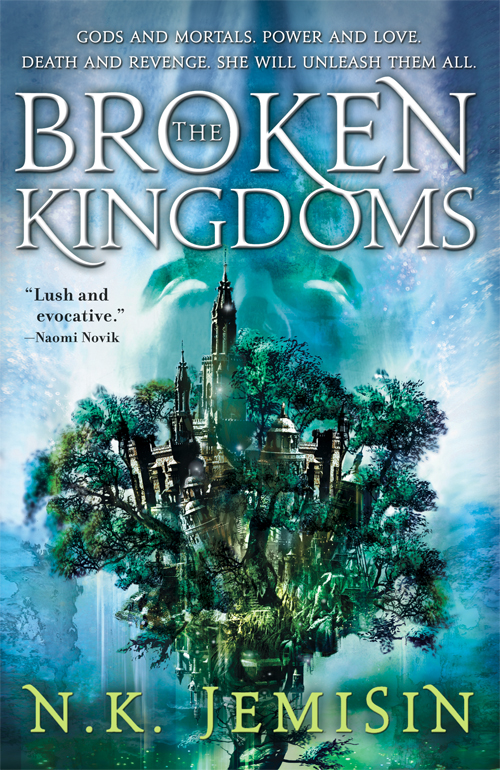
Review: The Broken Kingdoms by N.K. Jemisin
It begins ten years after the events in The Hundred Thousand Kingdoms. The Arameri family still rules the palace of Sky and all of the hundred thousand kingdoms of the world; however, a giant tree grows through the middle of the palace, and the city that hus sprung up at the foot of the Tree is called Shadow. Bright Itempas - once the only god worshipped of the Three - must contend with the worship of other gods, particularly two new ones, the Lord of Shadows and the Gray Lady. It is a time of change in the world.
Oree Shoth, a blind artist with a gift for painting who sells her trinkets and baubles in a market in Shadow, one day finds what appears to be a godling - one of the many children of the Three - in a muckbin. Oree has two gifts, really: painting, and the gift of sight through use of magic. She can follow godling footsteps, make outlines of them in the darkness of her world - when magic is used around her, Oree can see. Here is how Jemisin describes Oree seeing the godling, whom she's nicknamed "Shiny", one morning: "...he turned his gaze outward again, his hair and shoulders beginning to shimmer. Next I saw his arms, as muscled as any soldier's, folded across his chest. His long legs, braced slightly apart; his posture relaxed, yet proud. Dignified. I had noticed from the first that he carried himself like a king."
Shiny does not speak - not at first. Oree and he carry on a muted existence with Shiny constantly unaware of the dangers of his mortal-like body. Oree must clean up the blood of one of his fatal accidents more than once, but always, Shiny resurrects, emotionless and distant to his surroundings. It is not until Oree finds a godling murdered - a thing thought impossible - in an alley near her market that Shiny shows any outward sign of emotion. From here, The Broken Kingdoms spirals into the world of Shadow: against heretical and non-heretical priests of the Order of Itempas, down through godlings (one of whom was once Oree's lover), into the palace of Sky where Oree is burdened with a heavy revelation about herself, into darkness where one of the weirdest conglamarations of a demon ever written awaits.
It is the relationship between Shiny and Oree, however, that is at the heart of The Broken Kingdoms: how Shiny's disdain for mortalkind becomes begrudging respect and then, perhaps, something more; how Oree's initial dislike of Shiny's carelessness with his own body and his arrogance changes as she changes, discovering more about herself and the mystery of who and what Shiny really is. Jemisin seems very interested in understanding the differences and similarities of love and hate, and where the two collide.
There is also a lot of action in The Broken Kingdoms, yet Jemisin retains a meditative-like tone throughout. Her prose is clean and cool and, though she is working on a large canvas, her world-building rings true and nothing is unclear by novel's end. The voice of the story, however, really belongs to Oree. She is a strong, sympathetic character and Jemisin endears her to us. Though blind, she sees more than a person with perfect sight; yet, she is also flawed, blind to her own past. The aforementioned "heavy revelation" only adds to her complicated, interesting personality.
It's often said that the middle book of a trilogy is the least cohesive, it having to tie up loose ends from the first book while also threading new plot twists to be tied up in the concluding book. Jemisin avoids these pitfalls by letting the books stand alone, though reading them in order (her third, The Kingdom of Gods is due out later this year from Orbit) one can see her deft world-building and carry-over threads working gloriously. Recommended.
(Also recommended, The Hundred Thousand Kingdoms, the first book in the Inheritance Trilogy.)
-Dustin Monk
(Also recommended, The Hundred Thousand Kingdoms, the first book in the Inheritance Trilogy.)
-Dustin Monk
Monday, April 25, 2011
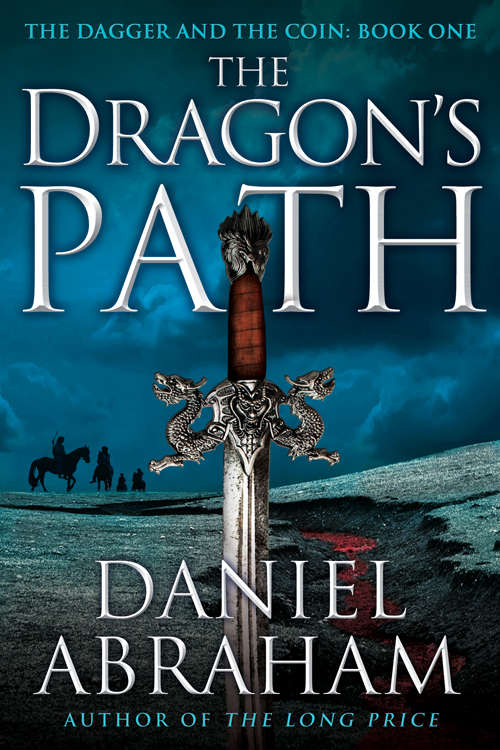
Review: The Dragon's Path by Daniel Abraham
The first book in Daniel Abraham's new fantasy series, The Dagger and the Coin, does not turn tropes on their heads or reinvent the genre; instead, what Abraham is concerned with is engaging fantasy - including its strengths and weaknesses - on its own terms. Indeed, in the "Extras" section at the end of The Dragon's Path, Abraham discusses having "permission to be part of a greater body of literature." Where his first fantasy series, the critically acclaimed and excellent Long Price Quartet, gave readers an interesting and new take on magic and placed it outside the traditional Medieval European setting, The Dragon's Path travels the rutted road of many epic fantastists - yet, it has all of Abraham's charm and wit, making The Dragon's Path an entertaining and engaging read.
The most interesting characters in The Dragon's Path are Cithrin and Geder, however, because their actions, at the best times, are morally ambiguous, deeply affecting, and, most important, truly human. When Geder is forced into a position of power, his conclusion of Vanai sets in motion various other power plays in the kingdom of Antea, where Geder hails from, and eventually sets him out on a journey unlike anything he's known. As dangers coalesce around Cithrin, her decision concerning the wealth of Vanai will potentially make her a very powerful woman - as war hits the continent, many nations may depend on loans from her branch. Both Geder and Cithrin make good and bad choices. Geder's naivete and near-sociopathic tendenies will have you cursing him at some points in the book; yet, in the end, you want Geder to win or, at least, do something right. Cithrin, too, is a complex character: her growth from a frightened girl in a world of unknowns to a confident banker is marvelous, though she is still fueled by the folly of youth.
The world Abraham's built is based around the end of the reign of dragons and the creation of the thirteen races of man. He spends most of the novel with the Firstbloods, glossing over the other twelve races with superficial detail - "tall-eared Tralgu, chitinous Timzinae, tusked Yemmu...The Dartinae had small braziers in their eyeholes...a Kurtadam with clicking beads." If there is a weakness in The Dragon's Path, it's here; however, this being the first book in a series of an expected five, it's possible Abraham well get more in depth with these races as they become important to the tale. Part of the first book in a series of this magnitude is setting up the world, letting the reader know the rules, and Abraham succeeds in that.
Beyond the political intrigues and banking contracts, Abraham has constructed an interesting if familiar back story concerning the age of dragons (who are now extinct, but left jade roads called "dragon roads" in their wake), and a temple of priests who can tell whether or not a person is lying and are concerned with the End of All Doubt and a very nasty spider. The revelation of the "End of All Doubt" is Abraham's intriguing spin on the "looming darkness" or "freeing of the great evil lord" common to commercial epic fantasy; it'll be exciting where he leads us.
Though The Dragon's Path shares similarities with past epic fantasy series', Abraham knows his strengths as a writer and, what might come off as cliche in a lesser writer's pen, here reads excitingly fresh. Recommended.
-Dustin Monk
Saturday, April 16, 2011
Review: The Enterprise of Death by Jesse Bullington
Enterprise follows Awa - lesbian African slave and reluctant necromancer - on her strange journey to find the book that may (or may not) break the curse her master put upon her through a Europe in the midst of the Spanish Inquisition. Along the way Awa encounters fictional and nonfictional characters alike - from the pistol-toting mercenary Monique to the real-life Reformationist and artist, Niklaus Manuel of Bern. Some of these people help her, others seek to destroy her and name her for what she is; throughout, however, is Awa's perserving spirit.
If Enterprise's humor is sometimes darker and smattered less generously than its predecessor, it's because, at is heart, Enterprise is a more serious and deeper investigation into our humanity. Bullington isn't afraid to tackle questions of morality, particularly whether the performance of necromancy is good or evil, because Awa - for all that she is a witch and raises the dead with or without their permission - is trying to live the best possible life a black homosexual woman with supernatural powers can live during the Inquisition.
Bullington utilizes his writing strengths - clever, gritty prose and witty asides - much as he did in his debut. The difference is, instead of the heretical graverobbing murdering bastards at the heart of Grossbart, Enterprise has characters - despite their many sins - you can root for. Manuel and Monique, and especially Awa, all strive for genuine goodness. But, as Awa surmises, "The problem with telling tales about real people [is] no summary can convey every truth, every facet, and what is good for the hare is not good for the fox."
Enterprise skillfully continues the macabre niche Bullington is carving out for himself, but also brings something new to his table.
-Dustin J Monk
Sunday, April 10, 2011
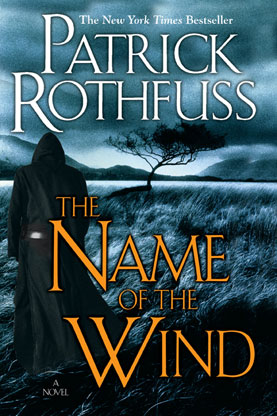
Not Really a Review: "The Name of the Wind" by Patrick Rothfuss
As part of my ongoing mission to read my heroic fantasy this year, I finished The Name of the Wind by Patrick Rothfuss about a week ago and I've spent that time reflecting on the story. For those of you what haven't read it yet, Wind is the first book of a planned three in the Kingkiller Chronicles and is the story of Kvothe - hero, magician, innkeeper - as told through his own eyes. The books (the second book, Wise Man's Fear, is out now from DAW) have been likened to "Harry Potter for adults," and I suppose the comparison is an apt one, at least for Wind; though Rothfuss' awareness of fantasy tropes and pitfalls saves him from rehashing well-worn territory.
In this first installment, we journey with Kvothe from his small beginnings in a traveling theater company and finally to the University where he studies magic (or "sympathy" as Rothfuss as reimagined it), with some hard times between. Rothfuss' aforementioned knowledge of fantasy fiction lets him outmaneuver - or, at least, make light of - old cliches. He's a crafty fellow and just when you think you know what's coming...well, you don't.
Kvothe is, at times, a self-deprecating narrator and quite humorous. It's rare a book makes me laugh out loud, but this did on several occasions - in particular, there is a scene with a "wizened but half-mad Master" at the university who requires Kvothe to do something dangerous in order for him to be taught by this Master and, let's just say, the results are hilarious.
What really struck me in Wind wasn't the avoidance of cliches (though it truly is a breath of fresh air) or the humor, but it was the depth, the closeness, of character. I've read a lof of epic fantasy in the past and, too many times, either the characters were not developed enough or secondary characters were so utterly rendered that I didn't know why the story wasn't about them. Rothfuss, however, knows every one of the people that populate the story inside and out - I felt like I knew Wyl and Sim and Denna, as if we were all old chums - but masterfully lets us know only what we need to know, at the moment. For a story on as grand a scale as Wind is, this is no easy feat.
In March I had the opportunity to see Rothfuss read at the Borders in Oak Park. I was too timid to ask question (but next time I swear I'll ask if he really is in a beard-off with George RR Martin), but several other folks asked some great questions concerning language and dialogue, specifically about the characters in the books. A lot of Wind's character descriptions are through dialogue - in that, how they speak and what they say when they do gives the reader a mental picture of what they character looks like. Old Cob is a perfect example of this: I don't remember a single line about what Cob looks like except that he's "old" but through his dialogue I know exactly what he looks like. It's pretty cool when a book can do that.
I highly recommend The Name of the Wind for everyone. You don't have to like epic fantasy to like this book. Though I've got a few other books lined up to read before I get to the second book of the Kingkiller Chronicles, I'm eager to read it.
Wednesday, March 16, 2011
Review: The Ouroboros Wave by Jyouji Hayashi
The Ouroboros Wave by Jyouji Hayashi is one of those "hard sf" novels packed with ideas. Technically speaking (that's not really a pun, but it kind of is), Ouroboros is not a novel: it's a series of interlinked short stories detailing humankind's accidental stumble into the stars; though every discovery pushes us closer to an understanding of our place in the universe. Indeed, Hayashi's motif throughout is "happensance is necessity in disguise."
The first of these interlinked stories concerns a black hole discovered by, you guessed it, happenstance. What's particularly interesting about the black hole, dubbed Kali - the Hindu goddess of destruction - is that it's on a collision course with the sun, our sun. Unfortunately, scientists are unable to determine if that collision will be in a few hundred years or in a few thousand. Rather than wasting time debating, an artificial accretion disk is built around Kali to not only change its course toward Uranus, but also, once in orbit around the gas giant, to harness the black hole's "boundless energy." However, in these early development stages, an AI nicknamed Shiva begins exhibting signs of awareness outside of cyberspace - that is, human-like intelligence - and endangering the scientists living on the artificial accretion disk.
In fact, what Hayashi is most concerned with throughout these stories besides proving that happenstance is masked necessity is determining what is and is not intelligent. In another of the stories, a submarine is encapsulated in the mouth of a giant jellyfish-like creature in the icy oceans beneath the surface of Europa; this creature may or may not be the first signs of intelligent life outside of Earth. In another, an assassin must out-think a complex system of identification modules to make her target. Is Hayashi also asking the question: is intelligence formed from happenstance?
We haven't even discussed the surplus of cool sf ideas rampant throughout Ouroboros. For instance: Amphisbaena, the needle-like station in orbit around the artificial accretion disk that houses the scientists; the web system of data transfer; the AI Salmon; the different political structures between Earthborn and Spaceborn peoples; etc.
If there is one detriment to Hayashi's Wave, it's the prose. The prose is so dry at times it's like reading sandpaper. I don't know if Hayashi's voice is this dry in the original Japanese or if something was lost in Jim Hubbert's translation; either way, it can make for tedious reading. There is also a lot of "telling, not showing," in the text, which is one of my pet peeves. The redeeming quality (other than the wealth of ideas and an interesting backstory) is that because Ouroboros is hard sf - I mean, extreme hard sf - the reader can get easily lost in those large, scientific words, but Hayashi is a master of making big concepts (like exactly how an artificial accretion disk might harness the energy of a black hole) easily understood.
The Ouroboros Wave is worth the read; however, if you're not a deep lover of hard sf (and, typically, I am not) you're going to have to get through some pretty serious slog to enjoy the story.
Tuesday, March 15, 2011
Robert Walser's The Microscripts
I stumbled across The Microscripts by Robert Walser in Unabridged Books in Chicago a few weeks ago. The Microscripts are several short stories (actually several hundred, culled and translated from the German tomes Das Gesamtwerk in 12 Banden and Aus dem Bleistiftgebiet) written by Walser in a tiny "secretive" script on the backs envelopes, movie tickets, torn-out pages of magazines and calendars. Unfortunately, I didn't have enough money to buy the book at Unabridged, but, after perusing its pages there in the store, I knew I had to have it.
Walser was the kind of writer who could sit down at his desk and write a novel in a matter of weeks or days; famously noted as not ever having revised a word as he wrote. He was constantly seeking a way to write quicker, leaner prose and in this way he began writing, as Susan Bernofsky - Walser's biographer and translator - says, in a "miniaturized Kurrent script, the form of handwriting favored in German-speaking countries...an e is represented by a simple pair of vertical ticks like a quotation mark, an s by a mere slash..."Walser was only moderately successful in his lifetime and, as a deeply troubled person, spent most of his later years in a sanitarium, having been diagnosed with schizophrenia. He was also said to be a huge influence on Franz Kafka.
Uusally preceeding the microscripts are the slips of envelopes or book covers or torn-off triangles of drawing paper Walser used to write his stories on. These reproductions are a colorful texture to the book, giving the reader a glimpse of Walser's handwriting and, in a larger sense, his attempts to write smaller and smaller stories (Walser wrote his final novel, The Robbers, first in microscript format). The back of the book also contains the untranslated stories.
The stories contained in The Microscripts concern all sorts of things: alcohol abuse, marriage, pigs, jealousy, love and lust. What struck me was the juxtaposition of Walser's tiny script and the "big" ideas contained therein. I think he wanted to say as much as possible with as little as possible. In this way, Walser was a Romantic, perhaps hopelessly so. As he writes in the microscript New Year, "The story keeps on going, and the beauty of a context is revealed."
Friday, March 11, 2011
Simplex Thoughts: Babel-17 & Conversation in the Cathedral
The last two books I finished, Conversation in the Cathedral by Mario Vargas Llosa and Babel-17/Empire Star by Samuel R. Delany, have been reviewed and analyzed to death, so instead I'm going to give my initial, visceral reactions to both. Know that I find both novels to be wondrous works in their own right.
I found Empire Star - the novella that accompanies the main novel - to be just as interesting, but in far different ways. Empire Star is half Flowers for Algernon and half mini-bildungsroman. Though Babel-17 is not, Empire Star is cyclical in process and it's always entertaining to watch a writer working toward something you know will pay off (in dividends!!) in a later work.
Empire Star is also a meditation on the actions of our choices and our perception of - not necessarily what is right and wrong - but how we choose what is right and wrong. Delany uses three different perceptions of thought - simplex, complex, and multiplex - to make his argument. (This might be a simplex way of putting it, by the way.)
This book was difficult to wade through. Sometimes on one page there are three or four conversations happening at once - several happening as past events and usually one happening in the present. It's a little disorienting. Okay; it's a lot disorienting. Never have I read a book where the feeling of vertigo has come over me so often or with such force. Once you realize this is happening and you can kind of ground yourself - figure out which is up and which is down (and it changes chapter to chapter, by the way) - then the story becomes clear. It's a pretty simple message Conversation conveys: dictatorships are evil. However, Vargas Llosa imbues his characters - the good and the bad - with such moral ambiguity it's clear that, on both sides, there are good and bad people - and that's what makes great literature. Essentially, what Vargas Llosa is doing is working toward an understanding of the monstrous within each of us.
Another way of putting this: Conversation in the Cathedral is very, very bleak. Even if the economy and government institutions have gotten better in Peru than during Vargas Llosa's writing, sadly, a lot of the discourse presented within the story will resonate today when we look at what's been happening, most immediately, in Egypt and Libya, but elsewhere as well in places like North Korea and Zimbabwe.
Babel-17/Empire Star
Chip Delany, whether he knew it or not, had been (and perhaps still is) working toward a particular conceit in his fiction: the novel as cyclical process; language, of course, its defining principle. This idea culminated, in my opinion, with his 1975 novel Dhalgren, but diagrams of the idea existed, perhaps starting with Babel-17/Empire Star and onward with The Fall of the Towers trilogy and the Neveryon series. In Babel-17, he explores the idiosyncracies of language, including body language and the minuteness of facial expressions. The main character of the novel, Rydra Wong, is a kind of telepathic linguist, in that she can determine what you're thinking or what you're about to say by the way you shrug your shoulders or the slight lift at the corners of your lips.
What struck me the most while reading Babel-17, however, was the differences in various languages (for instance, the sounds of L or R or V or W, etc), though I am aware this conflict, having studied Thai and French and some German; and the inferences we make about a person or people concerning our own limited knowledge of language.
I found Empire Star - the novella that accompanies the main novel - to be just as interesting, but in far different ways. Empire Star is half Flowers for Algernon and half mini-bildungsroman. Though Babel-17 is not, Empire Star is cyclical in process and it's always entertaining to watch a writer working toward something you know will pay off (in dividends!!) in a later work.
Empire Star is also a meditation on the actions of our choices and our perception of - not necessarily what is right and wrong - but how we choose what is right and wrong. Delany uses three different perceptions of thought - simplex, complex, and multiplex - to make his argument. (This might be a simplex way of putting it, by the way.)
Friday, February 25, 2011
Review: The Fixed Stars: Thirty-Seven Emblems for the Perilous Season by Brian Conn
The story is centered around John's Day, a celebration of the perverse and the barberous. A community regularly quarantines itself from plagues and copulates with each other quite vigorously. Some get lost in the woods, others get lost in a bathhouse. There are mentions of post late-capitalists. There are sections in the book that neither seem to have any purpose within its own context or, to be more particular, to forward, in any way, the plot. Many readers might see this as a flaw in the action of a novel; however, Conn has something to say you: who cares, plots come and plots go, threads are threaded and then, just as quickly, unthreaded, or prove themselves to be false threads.
What I'm getting at is that The Fixed Stars is so alien to read it is hard to grasp. The characters and the world portrayed within are so utterly unlike anything we know that, if you aren't prepared, will throw you out and it won't give a damn, not in the slightest. But if you want to experience a place that hasn't been experience before, The Fixed Stars is the place to go. I don't believe there is any way to fully understand entirely what Conn is driving at because he refuses, on any level, to give the reader anything to hold on to.
And yet. And yet, despite the lack of an empathetic character or a plot to understand, Conn imbues this world with a kind of sympathy that is also rarely seen in fiction. This world is as real and as relevant as our own. The final section is particularly heartbreaking. Though it's early in the year and this book was published in 2010, so far this is my favorite of the year.
Thursday, February 17, 2011
Not-Really-A-Review: The Bounty Hunters by Elmore Leonard
Rather than being blown out on westerns after watching the remake of True Grit and playing too much Red Dead Redemption, I have been thirsting for it like a lost cowboy in the desert looking for an oasis. Uhhh, bad analogies aside, I wanted to read a pulp western and who better a writer than pulp master Elmore Leonard?
The characters are fleshed out and I didn't find the Apaches stereotyped at all, which can sometimes be the case with pulpy westerns. Leonard's attention to detail is magnificent, as usual; and, of course, his dialogue, even at this early stage in his career, sparkles.
If you're looking for something to read because you're bored or you want something light with a lot of action and some tough-as-nails cowboys, I recommend The Bounty Hunters. I had to spend two days - gasp! - without the internets and I wanted something cool and quick: Leonard always delivers.
Monday, February 14, 2011
Review: The Sad Tale of the Brothers Grossbart by Jesse Bullington
The Sad Tale of the Brothers Grossbart, the debut novel by Jesse Bullington, is not for the faint of heart. The book follows antiprotagonists and twin brothers Hegel and Manfried Grossbart, graverobbing bastards and whoresons that they are, on their journey south from Germany to "Gyptland" for the riches of the Infidel tombs. Along the way they battle witches and manticores, demons and sirens; the brothers believing themselves fighting on the side of the Virgin (though this line of thinking may not be wrong, exactly, twisted as it is). It's sort of an anti-Odyssey with intermingling folktales, Nicolette's and the priest's tale as standouts. Sad Tale is written at times almost as an historical text (see the preface, specifically), but with closer points-of-view throughout so that the reader isn't too distanced from the pain and suffering and evil rampant throughout. Bullington wants you to feel this imagery and you do, you really do.
When it debuted, Sad Tale caused quite a ruckus because of its incredibly grotesque imagery and language and harsh depiction of Medieval Europe, and because it is difficult for readers to emphathize with its main characters, unless of course, you're an unsympathetic murdering bastard. Regardless, Sad Tale is a wonderfully readable and engrossing story. The Brothers Grossbard, for all their inane qualities, aren't stupid (or, rather, they're just smart enough). The bearded brothers are philosophers, debating theology with themselves and priests and laypersons throughout the novel; they are fierce fighters, unafraid of battle and death; they're crafty and remain cool under duress (for the most part); hell, they've got a sense of humor about things (I was laughing out loud as the brothers debated how many demons they killed and whether or not the pig was a demon; or Hegel's mistrusting of four-legged animals in general).
It is that playfulness, alongside the brothers' evil, that sets Bullington in a class all his own. In lesser hands, this book would've been too serious, too dark, too grotesque, too adrift without plot; but with Bullington it is all of those things and something more, something akin to perfection.
Thursday, December 2, 2010
The Thousand Autumns of Jacob de Zoet by David Mitchell - A Review
De Zoet also falls in love with a Japanese woman learning the art of midwifery, Aibagawa Orito. Though Orito seems inclined to return de Zoet's favors, she is sold to a nunnery by Lord Enomoto, a powerful Japanese businessman, to pay for her father's debts after he dies. There's something dark and mysterious happening at Shiranuai Shrine, where Orito lives, and it gives the story a powerful fantastical element. Could Lord Enomoto be over 600 years old?
It's not really the question Mitchell's novel wants to answer, but it makes for an intriguing turn of events. Japan was an isolated nation during this time with Dejima as its single European trading post; because of this, Japan's customs and her people seemed strange, otherworldly, certainly un-Christian, to the Western World. Mitchell has stated that he wanted to give the reader both the West and the East ample points-of-view because, too many times, a story like this concerning both sides is too narrow. He does this by breaking the novel into parts - the first and last half are seen through mostly de Zoet's eyes, with a few other narrative points-of-view thrown in from the Dutch and English; the middle section follows Orito and Osawa, the Japanese translator who had asked for Orito's hand in marriage but was denied by his own father. Even before Orito is sold to the nunnery, Ogawa and de Zoet become friends, but afterward, their relationship takes on a deeper meaning, when Ogawa asks de Zoet to hide a scroll detailing the strange and wicked tenants of Shiranuai Shrine and of Lord Enomoto's great sins. By the end, there is a certain understanding, a kind of familiarity, despite what is lost in translation, between de Zoet and Ogawa, as if the bridge between East and West, between the island of Dejima and the city of Nagasaki has been traversed.
The Thousand Autumns...has just about everything you could want from an epic: a battle at sea; unrequited love; a mountain escape; a game of go; a sinister lord; explosions and beatings; etc. But what the novel is ultimately about is: principles. Despite being thrown into the mix of rascals and ruffians, miscreants and ne'er-do-wells, de Zoet, Orito, and Ogawa follow simple principles - honor, honesty, and hard work - and hoping these principles are the foundations of a good life.
Final Verdict: Fantastically well-written and engaging. Even the smell of the pages - like fresh leaves - was great.
-Dustin J Monk
Thursday, November 18, 2010
Total Oblivion, More or Less by Alan DeNiro - A Review
Interspersed between the first person POV of Macy are interludes that delve into Macy's family's thoughts and actions. For instance, Grace, Macy's mother, fears the worst after she is infected with the plague. We learn that Sophia, the older sister, was attending college to be a midwife before the Scythians invaded. Ciaran's fate is revealed through transcripts.
But this is hands-down Macy's story. Total Oblivion is classic bildungsgroman. Through various adventures downriver - including a wooden submarine, an albino, a talking dog, wargiraffes, and a constantly shifting landscape - Macy discovers her strengths and weaknesses and a reaffirmation of her love for her family.
Macy dreams big and so does Alan DeNiro: sometimes the prose is purely absurd and out of control. The first two hundred pages read smoothly, if at times, as aforementioned, a bit absurdly wild, but the last third of the book feels incredibly rushed. This is because the first two hundred pages are more travelogue than story and the last third suddenly turns into a story. Rather than take his time to flesh out the ending, DeNiro throws it at the reader. What's worse is that it's pretty predictable.
Total Oblivion tries to find its heart and, though Macy is an intriguing sympathetic character, the story falls short.
Final Verdict: Enjoyable enough that I didn't want to mash frogs with a hammer.
--Dustin J Monk
Friday, October 22, 2010
Who Fears Death by Nnedi Okorafor - A Review
The story itself is pretty simple: Onyesonwu grows to be a headstrong child, not only because she is a woman with powerful sorcery who is refused the teachings of the Mystic Points because she is a woman; but also, she is Ewu - a half-breed, sand-colored, part Nuru and Okeke, a child born of violence who, it is believed, will bring more violence. Onyesonwu doesn't want to believe that she is violent - she who sings desert songs and brings owls and other animals to her shoulder, she who can shapeshift into vultures - but it was prophesied the Great Book would be rewritten. Only Onyesonwu knows if she is the bringer of this change. But she is haunted by her evil biological father who is trying to kill her.
It's what's going on underneath the story that makes it compelling. Usually, that's case, I suppose, but in Who Fears Death there's just so much of it! There's the plight of women, who - except in rare instances - have been relegated to the sidelines of society, taught that a man is her owner. Onyesonwu must overcome the prejudices and ignorance of a male-dominated world if she is to stand any chance of defeating her biological father and rewriting the Great Book.
Genocide is rampant. Nurus are killing Okekes by the thousands and Okeke rebels are fighting back, those that can. The story also deals with how inhumane humans can be to each other, based on the color of their skin, or the teachings from a book written hundreds, perhaps thousands, of years ago.
Let's not forget technology. Everywhere: rusty computers, static cell phones, the remnants of a technological society gone wrong. Who Fears Death is not afraid of talking about what happens when technology gets the better of us, and what becomes of us after.
It can be frightening to look at the world Okorafor has created because it isn't so different from our own. In fact, there were times I questioned if this was set in a post-apocalyptic world or in modern day Somalia. That the kind of things happening in Okorafor's story are happening in the real world - now - is heartbreaking and moving. Okorafor wrote a powerful novel that stands as a centerpiece for the problems of the world without sacrificing its own story. That takes guts. And love - because this is also a love story, of the cruelest, fullest kind. It doesn't get more Highly Recommended.
-Dustin J Monk
Subscribe to:
Posts (Atom)