Showing posts with label fantasy. Show all posts

Monday, November 7, 2011

NaNoWriMo Excerpt: Claw & Eye

The following is an excerpt from the novella I'm writing for NaNoWriMo. This is a pretty rough draft and already I can see where certain things need to change, sentences need tightening, bigger and bolder descriptions necessary, etc. In the interests of sharing and seeing how 1,667 words a day looks like (at least for me), however...well, here you go then:


Claw & Eye
By Dustin Monk


Worship of the ascendant eels begins beneath the city, in the Temple’s underground pools. Here is this man, Baldahlbrus, wearer of bowler hats, long coats, various beards (tonight is matted gray), with a limp he got fighting, and who dreams most every night of hiding in the thick, oily stalks of burningroot while around him the sounds of dying and short blasts of rifle fire carry on the wind, feeding an addict to the ascendant eels’ babies. The phosphorescent baby eels—who look like cold, white leaves and are sometimes called drifters because of the way they seem to float in the water when not eating: aimlessly, causeless—now nibble at the body like an angry mob, floating over him, illuminating his yellowy hair and knobby fingers and open, dead eyes with their phosphorescence. Their tiny, sharp teeth are stained ruby red.
            The addict must’ve died in the morning. Already his body stinks. Or maybe the stink is from the luminescent nerves twisted and knotted and thick as tree roots pulsing, clinging to the walls. The nerves smell like curdled milk.
Baldahlbrus stinks too—he smells of gasoline and vomit—but he will not bathe in this pool. The drifters will eat the living as heartily as they eat the dead. He watches. After a time the baby eels drift away from the addict’s carcass. What is left—shreds of meat and gristle and bone—sinks beneath the muddy green waters. He does not want to think about the amount of bones littering the bottom of the pool or what sort of monster they have formed.
He has knelt throughout the feeding. Now, he stands, feels out the limp in his leg, pulls his bowler hat closer to his eyebrows, straightens his long coat. The nerves along the walls pulse messages in bluish-gray but he cannot decipher what is said. Perhaps the message is: not so long ago we left and we are not coming back because we are dead. It might say that.
            His boots echo loudly on the stone tiles of the cavern dumb priests built to worship the ascendant eels in the bellies of their home. No one worships them anymore. He walks up the winding steps, click-clatter-clatter-click-clatter. Part of the roof of the grand chamber of the Temple has caved in. Large chunks of ceramic tiles lay scattered across the floor. Half-dead nerves—their ends the color of charred bodies, which Baldahlbrus has seen enough of—snap and fizzle like blown-out fireworks. Sister moonlight shines upon the gaping mouth of an ascendant eel painted on the floor. Once there were great sermons held in this chamber; a great many people knelt on the mouth of the eel. Now it glistens, lonely, as if mocking Baldahlbrus. I will devour what I please. Whatever was once treasured in this place is gone: chalices, painted windows, golden and gray curtains, the holy bowl.
            He pushes open the large wooden doors of the grand chamber, exits into the inner chamber and washes his face and hands in cracked clay bowls he’s found abandoned in alleys and filled with river water, and limps through the Temple’s smaller entrance into—

*

Nerve City. Night. Argana a pinkish pearl in the sky, looking down upon her thrumming, bleeding city, the cruel crater of her heart shimmering in streetlamps and in the eyes of addicts. Her twin Argala hangs behind a cloud in the shape of a frown. You were always the forlorn moon. Baldahlbrus gets out in it. Buildings rise like stark, bluish-gray tendrils—like thickened, widened mirror-others of the same nerves that cling to their facades—almost as if they too long for the ascendant eels’ return. The cobbled streets bustle in the dark.  Baldahlbrus steps around horse-pulled carriages, shit, and broken bottles. He averts his eyes from passersby: it is not good to know too many. Yet, he is not oblivious. Shadows stalk alleyways: half-illumined dealers form question marks against corners of buildings. Do you? Do you? Do you? Addicts get cold in the night too. In front of the brothel is Carakhi playing viola. Bevendraj’s eyes bulge as she looks at a huge clump of dirt in her hands. On the other side of the street, accosting passersby like the idiot he is is Galat, showing off his new silver tooth. A spiky-haired addict Baldahlbrus doesn’t recognize, shuffling back and forth in front of an abandoned grocery store, asks if he’s got it. He doesn’t.
In all the books he has read—and he hasn’t read that many—this is exactly what the end of the world looks like. It isn’t the end of the world, it is the beginning. It is the beginning of the world. That is a loop he gets easily caught in. The world spins as it sometimes does when he limps too fast and Baldahlbrus wishes Maj was here. He liked to lean on her and she let him sometimes. She hadn’t minded his limp either. Yes, I am in love with her. Almost as much as I am in love with getting so high the drifters talk to me. This isn’t how I find her. This isn’t my pining. She was a girl and I was a boy, once, and we were both soldiers and, hiding in the burningroot, we sometimes held each other. That is the kind of love I know.

Thursday, October 27, 2011

Best First Opening Lines of the Year (With Conditions)

I thought I'd do something fun in gearing up for National Novel Writing Month (NaNoWriMo) as well as the requisite "Best Of" lists that will populate this here bloggy-blog for the rest of the year, mostly. And that fun thing? Oh, you know, the 10 best first opening lines from novels or stories I've read this year - which means, of course, not all of these are from books or stories published in 2011, though most of them are. Are we having fun yet? Okay, great. Here goes:

10. "Interviewer: Can you introduce yourselves?
      "Alpha: We are third-generation intelligent agents of LogiComm Works, Inc., designed to calculate and settle agreements for our clients.
      "Beta: We are designed to filter out emotional noise factors that may prevent human agents from coming to an equitable resolution that maximizes efficiencies." - "Saving Face" by Shelly Li and Ken Liu (from Crossed Genres, January 2011)

9. "The tent is draped with strings of bare bulbs, with bits of mirror tied here and there to make it sparkle. (It doesn't look shabby until you've already paid.)" - Mechanique: A Tale of the Circus Tresaulti by Genevieve Valentine

8. "We sat on a hill. We watched the flames inside the balloons heat the fabric to neon colors. The children played Prediction." - Light Boxes by Shane Jones

7. "It began, in a way, with the midget hunchback tuk-tuk driver." - "Aphrodisia" by Lavie Tidhar (from Strange Horizons, August 2010)

6. "I'd never wanted to go to Earth until the doctor told me I couldn't, that my bones were too brittle." - "Long Enough and Just So Long" by Cat Rambo (from Lightspeed Magazine, Feb 2011)

5. "It is possible I already had some presentiment of my future." - The Shadow of the Torturer by Gene Wolfe

4. "For years the air above the earth had begun sagging, suffused by a nameless, ageless eye of light." - There is No Year by Blake Butler

3. "In some places, time is a weak and occasional phenomenon. Unless someone claims time to pass, it might not, or does so only partly; events curl in on themselves to form spirals and circles." - "The Aunts" by Karin Tidbeck (from ODD? Anthology, October 2011)

2. "There is no book about me. Well, not yet. No matter." - "The Book of Phoenix: Excerpted from The Great Book" by Nnedi Okorafor (from Clarkesworld Magazine, March 2011)

1. "Morning light the sulphur color of the mine dumps seeps across Johannesburg's skyline and sears through my window. My own personal bat signal. Or a reminder that I really need to get curtains." - Zoo City by Lauren Beukes

Monday, August 29, 2011

Reading: Mechanique: A Tale of the Circus Tresaulti by Genevieve Valentine

Mechanique: A Tale of the Circus Tresaulti, the debut novel by Genevieve Valentine, is the best book I've read so far this year. The language of the novel is poetic and hypnotic and moving. It's a short novel, but Valentine managaes to get across so much with so little - a gift if ever there was one, truly.

It's about a traveling circus in either an alternate Earth or a post-apocalyptic Earth. The circus is run by the enigmatic Boss, a woman with an ambiguous past and strange magical powers. In this circus, many of the performers are kept alive by adding mechanical components to their bodies - from Panadrome, the one-man orchestra, to Elena the aerialist with brass bones. Even as the circus is hounded by "government men," there is a quiet war between several performers and a pair of gold wings Boss keeps.

You might be saying to yourself, isn't the whole circus thing kind of worn thin? Perhaps so, but Valentine injects it with grace (sidenote: now I'm imagining a needle full of grace in my arm) and heartbreak. Even though it is a somwhat nonlinearly structured novel, every scene works toward its inevitable conclusion with surprising wonder. Supremely-doo-remely Recommended.

Here is a an excerpt from Mechanique: A Tale of the Circus Tresaulti:

Little George was slated to be fixed, but Boss keeps him out of the workshop even after he asks, and so he keeps moving slowly through time until he's older than Ying, until he's nearly as old as Jonah, who has been twenty-five since the day he came to the circus and was gifted with his clockwork lungs.

Slowly, Little George begins to wake up to the world in a way he cannont name.

He does not know that Ying will never be older; he does not know why he takes such care not to anger the Grimaldi brothers. He is not aware, only awake.

He knows nothing for certain; he only sees that when the government man is gone, the circus gathers in two groups to see what Boss will do: who are alive, and those who have survived the bones.

Thursday, August 18, 2011

Hugo Nominees: My Picks

Sadly, I won't be attending Renovation (Worldcon in Reno, NV, the king con of cons) this weekend so I will be unable to vote for the Hugo Awards - one of SF's most prestigious awards. Regardless, I intend to give you my picks in the categories where I'm familiar with the works or individuals nominated. You can find a full list of nominees here. I'll be attending next year's Worldcon in Chicago and I invite all of you to join in on the fun (and to read these books and magazines).

BEST NOVEL
The Hundred Thousand Kingdoms by N.K. Jemisin. The award will probably go to Connie Willis for Blackout/All Clear, but I'd choose Kingdoms any day over these two. I also find it kind of unfair that Willis has two books nominated as one; Jemisin's second book in her Inheritance Trilogy too and that book, The Broken Kingdoms, is also wonderful.

BEST NOVELLA
"The Lady Who Plucked Red Flowers beneath the Queen's Window" by Rachel Swirsky. Ted Chiang is a worthy adversary, but I believe Swirsky will take this one home. One of the best stories I've read in several years.

BEST NOVELLETE
"The Jaguar House, in Shadow" by Aliette de Bodard. This is a tough category. I really like James Patrick Kelly's "Plus or Minus," and Allen M. Steele's "The Emperor of Mars." Honestly, it's almost a toss-up between these three, but de Bodard's stands out a little more above the crowd.

BEST SHORT STORY
"The Things" by Peter Watts. Despite this story being based off John Carpenter's The Thing, it is amazing. Alas, it is also very tough to choose in this category. Both Kij Johnson's "Ponies," and Mary Robinette Kowal's "For Want of a Nail" are fantastic too.

BEST DRAMATIC PRESENTATION, LONG FORM
Inception, directed by Christopher Nolan. Despite its somewhat flawed conceit, this movie could've been a full-blown disaster and it wasn't. In fact, it was quite engaging. (Sidenote: I almost went with Scott Pilgrim vs. the World, but Scott didn't end up with Knives which was, to me, as infuriating as Duckie not ending up with Andie in Pretty in Pink. Come on, Knives is so cool!)

BEST EDITOR, SHORT FORM
John Joseph Adams. Lightspeed and Fantasy Magazines publish some of the best SF out there today.

BEST EDITOR, LONG FORM
Liz Gorinsky. I love Tor Books and Gorinsky is doing some amazing work there.

BEST SEMIPROZINE
Lightspeed Magazine. For the reasons stated in the Best Editor, Short Form section.

JOHN W. CAMPBELL AWARD FOR BEST NEW WRITER (not a Hugo)
Lauren Beukes. One helluva writer. I'm curious as to why Zoo City wasn't nominated for best novel.

Apologies to the best fanzines and fan writers and graphic stories, et cetera, but if I didn't pick from your category it's because I'm not familiar with the nominees. Hopefully, by next year, I will have rectified this ignorance. In the meantime, good luck to all the nominees!

Sunday, June 26, 2011

Clarion +1: A Year of Writing

This time last year I was on an airplane, nervous with anticipation, for a 6-week writing "boot camp" in San Diego. I was on my way to the Clarion Science Fiction & Fantasy Writers' Workshop. It is an intensive workshop taught by some of the best writers in the field. The instructors during my six weeks were Delia Sherman and Ellen Kushner, Dale Bailey, George RR Martin, Samuel R. Delany, Jeff and Ann Vandermeer. Their insights, as well as the insights of the seventeen other classmates (all of which I'm proud to call friends and who are some of the smartest writers you'll ever read), have inspired me to not only understand what it is I do better but, simply, to do it better. With that in mind (instead of waxing nostalgic in this post because, let's face it, I miss those Clarionites every day), I'd like to post a few of my accomplishments over the past year.

Since Clarion, I've had two short stories published in Aphelion Magazine, Prime Mincer Literary Journal, and one forthcoming from Digital Science Fiction in July. The story published in DSF is a revised Clarion submission story; and the story published in Prime Mincer was the story I submitted during the final week of Clarion.

Not including these three stories, I've completed 13 short stories - most of which are in the 4,500-5,500 word range, though some are longer, nearing novelette and novella status and some are flash fiction pieces, less than a thousand words. A few of these pieces have been submitted to various markets and are awating rejections/acceptances from editors and, though some have been trunked indefinitely, most are still in the revision process. Altogether, my total word count for short stories is approximately 47,500 words.

In November, I joined the National Novel Writing Month competition, completing half of a novel at 51,180 words. To be honest, I didn't finish it because I had decided to go into the competition without a game plan. It was actually a conscious choice - I wanted to see what it was like to write without knowing anything about the story or, at the very least, having the vaguest, roughest of outlines. The outline wasn't plot-centric; the character description was for only one charater, named Moo, and it went something like this: "Moo is a thief but he doesn't know it." Beyond that and a couple of names for worlds (this was a multi-dimensional galaxy spanning story), I had nothing.

What I've done the past few weeks, however, is returned to this novel to see if there was anything worth scraping. There is, in fact, a lot worth scraping, but I don't think the novel (or half the novel) works together. About two-thirds of the way through I break from the main characters to focus on a character that, though he was secondary to begin with, kept creeping up in the text to the point where 9,000 words was dedicated to telling his story, though his story had nothing to do with the main action. Reviewing the novel has shown me that there was a lot of interesting things going on that didn't have much to do with one another and, rather than try to tie it all up in some forced bow at the end, it seems the best way to handle the situation is to create two or three novellas out of it. This is exhilarating to me for a number of reasons. Chiefly, because it has been a long time since I've written anything over 10,000 words, and I've always enjoyed longer works (yes, I am obsessive over word count). I'm also excited because I really love the voices of several of the characters - Moo, Tok Willow, Nyanna, and Balador - and am looking forward to getting back into writing about them.

One of the other lessons learned from NaNoWriMo is that I need to plan if I'm going to attempt a novel. Between short stories, I've been jotting down notes for just such a task in a faded green notebook with a bird on a limb that I markered in black permanent marker. By the end of July, I'd like to seriously start working on it. (I've always read more novel-length works than short stories anyway and, in much of the feedback from editors and beta readers, I've been told there is enough material within some of my short fiction to extend into a novella or novel. Let's hope that's true.)

My sister Mandy and I also worked on a moleskins project together. This consisted of me writing a very short story (sometimes more than one in a single volume) in a moleskin notebook, leaving blank pages at certain intervals in the tale. Mandy would draw pictures to coincide with the themes or scenes from the story. I think we made eight of these. Several sold at Spencer Bell Legacy shows my band, Tin Tin Can, performed at.

Currently, I am working on four stories. Two of them are science fiction, a third is horror, and the fourth has elements of heroic fantasy though it isn't quite that. The first of science fiction pieces, tentatively titled "The Contra-Tuba's Soul," is coming along nicely though it, like a lot of my fiction, wants to be longer than I initially thought it would be; the other science fiction piece, tentatively titled "Sleeping Bird," is in its beginning stages, even though I had the idea for it the fifth week of Clarion. The horror piece is a story I wrote at Clarion, titled "Crooked Letter, Crooked Letter, Aye," but I never submitted it for critiques because it really wasn't a story yet - it was a piddly thing of no significance, full of gratuitous sex and violence (instead, I wrote and submitted a terribly sentimental piece about an elderly lady taken to a sock hop by an alien and which caused Jeff Vandermeer, co-instructor that week, to exclaim, in full lambasting glory, "It's as cheesy as Beaches!"). After some thought, however, I've decided to retool the story because, despite most of the action, I'm fond of the narrative voice. The sort-of-heroic-fantasy story concerns a small island village and the soldiers who return home from a war. It is a melancholic piece. It's the kind of story where all of the elements fall into place and the world is so vividly realized for me that all I really have to do is type.

Looking toward the future, I'll be working on the above-mentioned novel from my bird-on-a-limb notebook, as well as piecing together - or pulling apart, rather - the two or three novellas from the NaNoWriMo half-novel. I also have several ideas - some of which have been floating around in my head since December (and one since 2005, eesh) - for a few other novels, so I'll begin writing notes for these soon. I also hope to continue writing short fiction: thankfully, every time I fear I'll run out of ideas for short fiction, another one inevitably comes along.

So. The final word count - it always comes down to the final word count, doesn't it? - for the first year post-Clarion is 98,680 words. I've had 3 acceptances, 4 currently pending, and 43 rejections. Before Clarion I wasn't serious about writing - I had written one and half novels when I was 19, five short stories in college, and two since graduating that were rejected from one literary magazine each and trunked. In fact, I'd only decided to get serious about writing shortly before being accepted to the workshop, starting off by writing something - anything - every day, no matter what. I've done that, almost without fail, for over a year now. But, since Clarion and my wonderful classmates' and instructors' techniques and insights, I do so with a better understanding of the craft and labor of writing. Thank you all.

Monday, June 6, 2011

Review: Last Dragon by J.M. McDermott

Last Dragon, the debut novel from J.M. McDermott, is a visceral, magical, and at times indefinable, experience.
At first glance, the “plot” (in quotes because the story is only marginally concerned with it) is simple enough: Zhan, a warrior-in-training from the north land of Alameda, discovers that her grandfather has savagely murdered her entire family, excluding her Uncle Seth, a shaman; Zhan journeys south with Seth to bring her grandfather to justice. However, Last Dragon’s nonlinear structure—relying on the beauty of a mosaic, a constant folding in on itself—and Zhan’s unreliable narrating create tension making an otherwise formulaic fantasy story sizzle.
The story is recounted through a series of vignettes written by an imprisoned Zhan, as morbid love letters to Esumi, her former lover. How and why Zhan is imprisoned is important and the revelation unexpected; however, what’s strange about it is the incident that led to her imprisonment takes place outside the events contained in Last Dragon. Regardless, the animosity toward and—contradictory—pleading for Esumi to respond to her letters adds complexity to Zhan’s character early on: “Esumi, you have promised me forever, too. Where are you now? You choose an empire over your own heart. This pain I endure every day, where you are missing, is more painful than any cough.” And later: “Should I tell you anything? You who does not write to me. You do not speak to me. You whom I love. You, my love.”
There are several beginnings to Last Dragon, but McDermott has chosen to begin with Zhan in the southern city of Proliux, already having been separated from Seth. Zhan lives on the streets, searching in vain for her grandfather. Here, she meets Adel—a well-connected woman with a dubious past, who was once a paladin of the last dragons. Sympathetic to the young Zhan’s cause, Adel agrees to help her find her uncle and grandfather.
The story then folds back on itself, beginning again with Zhan and Seth as they travel south through the forests and hard lands of Alameda. Eventually, they find passage on a ship heading south to Proliux. Because Zhan was training to become one of the warrior-women of her people, she must rely on Seth’s recollections of how her grandfather had murdered her village. But Seth is a moody shaman and mostly silent on the matter, instead keeping to himself. Indeed, as they reach their destination, Seth intentionally loses Zhan in the crowded docks. With Adel’s help, however, Zhan eventually finds Seth living with Staf Sru Korinyes the gypsy.
It is rumored that Zhan’s grandfather may live under the protection of a Proconsul, one of the city’s leaders. Adel, having once been married to such a Proconsul, is able to get Zhan and Seth an appointment, to see that justice is done. Korinyes, a suspicious woman by nature, believes Adel may have other motives in play here. Regardless, Zhan seems to trust the paladin implicitly. However, Korinyes’s suspicions are not far off.
The Proconsuls have hired mercenaries to invade northern Alameda and conquer it for Proliux. Knowing this, Zhan and her small troupe journey north, managing to stay one step ahead of the encroaching armies, hoping to make contact with Prince Tsuin, the one who might be able to stave off invasion. If there is a flaw in this tale, it’s here: the motivations behind conquering a cold, hard land are never satisfactorily explained, except that conquering lands is what empires do.
Along the way, in the frozen north, Adel relates to Zhan the last moments of the last dragon: “His wings were cobwebbed with war wounds, and I don’t think he could fly anymore.” She also tells Zhan that “dragons live a long time because when they eat a person they acquire the life of the person. They never eat evil, or feebleminded things.” This conversation between Adel and Zhan is crucial to the story because it also asks the question: who is the dragon and who is the ant? Who eats whom?
Last Dragon moves around and beyond and around Zhan’s encounter with her grandfather. This, like the conversation about dragons, is a heavy experience, and one that shapes Zhan thereafter. Yet, the telling of it is difficult. As she explains, “My fingers are like spiders drifting over memories in my webbed brain. The husks of the dead gaze up at me, and my teeth sink in and I speak their ghosts. But it’s all mixed up in my head.” As two or three plot threads knot together, a new thread (or two) unravels. This process of knotting and unraveling is continuous throughout Last Dragon, so much so that even the end of the story is also a beginning.
In other words, Last Dragon requires a healthy amount of focus from the reader. This is not something that should deter; rather, a concentrated reading rewards the reader with deeper insights into Zhan’s motivations as her world changes around her. Make no mistake: McDermott’s gorgeously poetic prose is most certainly compelling, though some might deem this a “difficult” novel. The only thing difficult about it is that every sentence, every word, carries weight. Though it may, in some instances, rely on fantasy tropes (read: dragons and magic and smelly cities and epic quests), this cannot be stressed enough: Last Dragon is foremost a reading experience and, if engaged with appropriately, an entertaining one too. Recommended.

Tuesday, May 17, 2011

Review: Deathless by Catherynne M. Valente

Catherynne M. Valente continues her mastery of turning fairytales on their heads in her latest, Deathless. Set against Stalinist-era Russia, Deathless tells the story of Marya Morevna, youngest of four sisters, and Koschei, called Deathless, the Tsar of Life.

Each of Marya's sisters marry men who previously had been birds fallen from the tree outside Marya's window. Marya waits for her magical bird-man to swoop and whisk her away too; instead, eleven other families move in to the house and, in an attempt to escape the encroaching claustrophobia, Marya falls in with the house's magical creature-protector-imp Zvonok, a domoviye. Zvonok introduces Marya to an invisible world, a world of magic, of the Tsar of Life and Tsar of Death, to a place only a few humans have ever visited.

Finally, a man comes for Marya: Koschei the Deathless, the Tsar of Life. In Russian folklore, Koschei is usually depicted as villainous and, though he can be monstrous in this retelling, Valente invests enough empathy in him a small amount of tenderness and love leaks from beneath his savage veil. And Marya, in love with Koschei, yearns to become a queen of this invisible world, of the island of Buyan; however, she must successfully complete three tasks set by Koschei's sister, Baba Yaga.

Deathless isn't escapist fantasy, however; being Koschei's queen is not how Marya Morevna survives the Stalinist regime and the siege of Leningrad during World War II. Instead, Marya experiences the horrors of war firsthand on two levels: 1) the "comprehensible, real" world and 2) the magical realm of Koschei. Marya moves between these worlds, fighting in a war between Koschei and Viy, the Tsar of Death, a war they've been waging since time began, and surviving during the siege of Leningrad. Valente balances these paralleling worlds - the real and the fantastic - with skillful grace. As Marya recounts to her magical friend, Comrade Lebedeva, "If a novelist wrote a true story about how things really happened, no one would believe him, and he might even be punished for spreading propaganda. But if he wrote a book full of lies about things that could never really happen, with only a few true things hidden in it, well, he would be hailed as a hero of the People..." It is the hiding of these "few true things" that makes Deathless so compelling - the chapter concerning the siege of Leningrad seen through Zvonok the domoviye's point of view is particularly affecting, as is the push-pull nature of Marya and Koschei's marriage.

Adding to this intriguing fairytale is Valente's captivating prose. Her words are always full, nearly bursting with wonder, and Deathless is Valente at her finest. Here is an example (Zvonok speaking to Marya):

Last week a man held a concert Glinka Hall. Snow fell in through the broken roof the whole time, piling up on the oboist's head. The air raid sirens played, too. We all listened from the roofs. Like cats. But not like cats. There are no cats left in Leningrad. Ivan said, If only we could eat violin music. I kissed his thumbnail. He said he was glad of me. Then he crawled into that bed...

Valente expertly mixes a sense of dread and hopelessness with something like absurd normality: as families starve during the siege, a man holds a concert and everyone listens from the roofs of their houses. And even after Ivan wishes to "eat violin music" he says he is "glad of [Zvonok]." In the direst moments hope is still preserved.

In the end, Deathless is a dream: of different worlds - ours and the magical - coexsting together, understanding the differences between what is living and what is really dead, and where each of us belong. Recommended.

Also recommended: The Bloody Chamber and Other Stories by Angela Carter.

Thursday, April 28, 2011

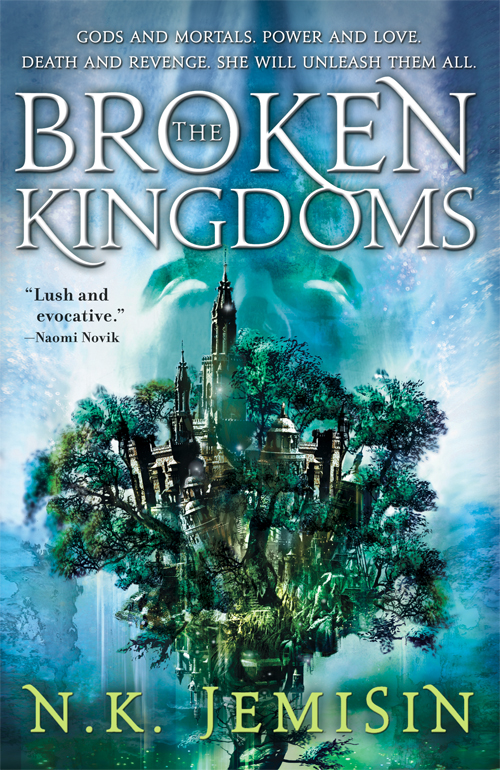
Review: The Broken Kingdoms by N.K. Jemisin

The Broken Kingdoms, the second book in N.K. Jemisin's Inheritance Trilogy, is, simply put, wonderful. Jemisin has crafted an intelligent, entertaining and, ultimately, heartbreaking sequel to The Hundred Thousand Kingdoms.

It begins ten years after the events in The Hundred Thousand Kingdoms. The Arameri family still rules the palace of Sky and all of the hundred thousand kingdoms of the world; however, a giant tree grows through the middle of the palace, and the city that hus sprung up at the foot of the Tree is called Shadow. Bright Itempas - once the only god worshipped of the Three - must contend with the worship of other gods, particularly two new ones, the Lord of Shadows and the Gray Lady. It is a time of change in the world.

Oree Shoth, a blind artist with a gift for painting who sells her trinkets and baubles in a market in Shadow, one day finds what appears to be a godling - one of the many children of the Three - in a muckbin. Oree has two gifts, really: painting, and the gift of sight through use of magic. She can follow godling footsteps, make outlines of them in the darkness of her world - when magic is used around her, Oree can see. Here is how Jemisin describes Oree seeing the godling, whom she's nicknamed "Shiny", one morning: "...he turned his gaze outward again, his hair and shoulders beginning to shimmer. Next I saw his arms, as muscled as any soldier's, folded across his chest. His long legs, braced slightly apart; his posture relaxed, yet proud. Dignified. I had noticed from the first that he carried himself like a king."

Shiny does not speak  - not at first. Oree and he carry on a muted existence with Shiny constantly unaware of the dangers of his mortal-like body. Oree must clean up the blood of one of his fatal accidents more than once, but always, Shiny resurrects, emotionless and distant to his surroundings. It is not until Oree finds a godling murdered - a thing thought impossible - in an alley near her market that Shiny shows any outward sign of emotion. From here, The Broken Kingdoms spirals into the world of Shadow: against heretical and non-heretical priests of the Order of Itempas, down through godlings (one of whom was once Oree's lover), into the palace of Sky where Oree is burdened with a heavy revelation about herself, into darkness where one of the weirdest conglamarations of a demon ever written awaits.

It is the relationship between Shiny and Oree, however, that is at the heart of The Broken Kingdoms: how Shiny's disdain for mortalkind becomes begrudging respect and then, perhaps, something more; how Oree's initial dislike of Shiny's carelessness with his own body and his arrogance changes as she changes, discovering more about herself and the mystery of who and what Shiny really is. Jemisin seems very interested in understanding the differences and similarities of love and hate, and where the two collide.

There is also a lot of action in The Broken Kingdoms, yet Jemisin retains a meditative-like tone throughout. Her prose is clean and cool and, though she is working on a large canvas, her world-building rings true and nothing is unclear by novel's end. The voice of the story, however, really belongs to Oree. She is a strong, sympathetic character and Jemisin endears her to us. Though blind, she sees more than a person with perfect sight; yet, she is also flawed, blind to her own past. The aforementioned "heavy revelation" only adds to her complicated, interesting personality.

It's often said that the middle book of a trilogy is the least cohesive, it having to tie up loose ends from the first book while also threading new plot twists to be tied up in the concluding book. Jemisin avoids these pitfalls by letting the books stand alone, though reading them in order (her third, The Kingdom of Gods is due out later this year from Orbit) one can see her deft world-building and carry-over threads working gloriously. Recommended.

(Also recommended, The Hundred Thousand Kingdoms, the first book in the Inheritance Trilogy.)

-Dustin Monk

Monday, April 25, 2011

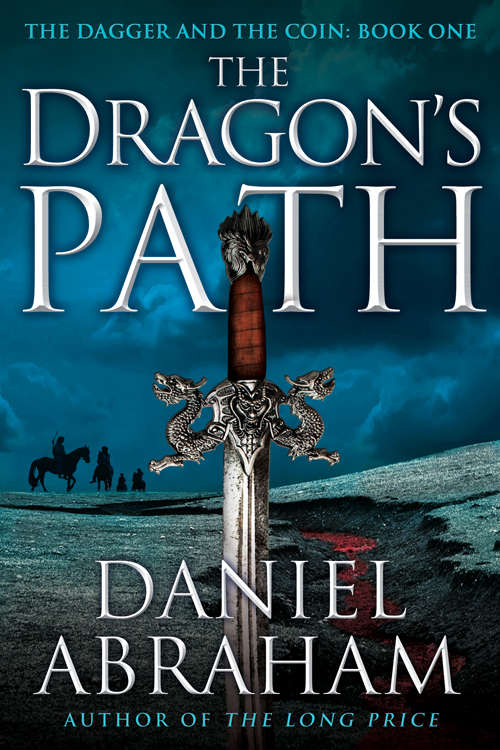
Review: The Dragon's Path by Daniel Abraham

The first book in Daniel Abraham's new fantasy series, The Dagger and the Coin, does not turn tropes on their heads or reinvent the genre; instead, what Abraham is concerned with is engaging fantasy - including its strengths and weaknesses - on its own terms. Indeed, in the "Extras" section at the end of The Dragon's Path, Abraham discusses having "permission to be part of a greater body of literature." Where his first fantasy series, the critically acclaimed and excellent Long Price Quartet, gave readers an interesting and new take on magic and placed it outside the traditional Medieval European setting, The Dragon's Path travels the rutted road of many epic fantastists - yet, it has all of Abraham's charm and wit, making The Dragon's Path an entertaining and engaging read.

Part of what Abraham does so well is write compelling characters. This is epic fantasy, to be sure, but the important players in The Dragon's Path are not great warriors or sorcerers or sorceresses (though, each of these certainly make appearances). There is Cithrin, an orphan and ward of the Medean Bank, who must smuggle the free city of Vanai's wealth across the countryside after her city is sacked. And Geder Palliako, the "lone scion of a noble house" who is more interested in speculative essays than swordplay, and is constantly made fun of for it. Marcus Wester is the closest Abraham gets to a great warrior; however, Marcus's glory days (tinged with tragedy though they are) are well behind him and he has become a mercenary and caravan guard. Dawson Kalliam, childhood friend of the king of Antea, is a man of tradition, whether right or wrong, and will do anything to keep the kingdom from falling. His wife, Clara, also plays into the action near the end of the novel - she is certainly more intelligent than Dawson and has a better grasp of court politics and the great changes sweeping through the kingdom.

The most interesting characters in The Dragon's Path are Cithrin and Geder, however, because their actions, at the best times, are morally ambiguous, deeply affecting, and, most important, truly human. When Geder is forced into a position of power, his conclusion of Vanai sets in motion various other power plays in the kingdom of Antea, where Geder hails from, and eventually sets him out on a journey unlike anything he's known. As dangers coalesce around Cithrin, her decision concerning the wealth of Vanai will potentially make her a very powerful woman - as war hits the continent, many nations may depend on loans from her branch. Both Geder and Cithrin make good and bad choices. Geder's naivete and near-sociopathic tendenies will have you cursing him at some points in the book; yet, in the end, you want Geder to win or, at least, do something right. Cithrin, too, is a complex character: her growth from a frightened girl in a world of unknowns to a confident banker is marvelous, though she is still fueled by the folly of youth.

The world Abraham's built is based around the end of the reign of dragons and the creation of the thirteen races of man. He spends most of the novel with the Firstbloods, glossing over the other twelve races with superficial detail - "tall-eared Tralgu, chitinous Timzinae, tusked Yemmu...The Dartinae had small braziers in their eyeholes...a Kurtadam with clicking beads." If there is a weakness in The Dragon's Path, it's here; however, this being the first book in a series of an expected five, it's possible Abraham well get more in depth with these races as they become important to the tale. Part of the first book in a series of this magnitude is setting up the world, letting the reader know the rules, and Abraham succeeds in that.

Beyond the political intrigues and banking contracts, Abraham has constructed an interesting if familiar back story concerning the age of dragons (who are now extinct, but left jade roads called "dragon roads" in their wake), and a temple of priests who can tell whether or not a person is lying and are concerned with the End of All Doubt and a very nasty spider. The revelation of the "End of All Doubt" is Abraham's intriguing spin on the "looming darkness" or "freeing of the great evil lord" common to commercial epic fantasy; it'll be exciting where he leads us.

Though The Dragon's Path shares similarities with past epic fantasy series', Abraham knows his strengths as a writer and, what might come off as cliche in a lesser writer's pen, here reads excitingly fresh. Recommended.


-Dustin Monk

Saturday, April 16, 2011

Review: The Enterprise of Death by Jesse Bullington

For readers expecting more gruesomeness, grotesquerie, and vulgarity from the author of The Sad Tale of the Brothers Grossbart, Jesse Bullington's second novel, The Enterprise of Death, will not disappoint. Cannibalism, necrophilia, venereal diseases, the walking dead (sometimes all at once!): Enterprise has these - and more! - in spades. "Pity Boabdil," Enterprise begins, and pity the reader with a weak stomach, for Bullington is a master at gritty, harrowing and awe-inspiringly macabre detail.

Enterprise follows Awa - lesbian African slave and reluctant necromancer - on her strange journey to find the book that may (or may not) break the curse her master put upon her through a Europe in the midst of the Spanish Inquisition. Along the way Awa encounters fictional and nonfictional characters alike - from the pistol-toting mercenary Monique to the real-life Reformationist and artist, Niklaus Manuel of Bern. Some of these people help her, others seek to destroy her and name her for what she is; throughout, however, is Awa's perserving spirit.

If Enterprise's humor is sometimes darker and smattered less generously than its predecessor, it's because, at is heart, Enterprise is a more serious and deeper investigation into our humanity. Bullington isn't afraid to tackle questions of morality, particularly whether the performance of necromancy is good or evil, because Awa - for all that she is a witch and raises the dead with or without their permission - is trying to live the best possible life a black homosexual woman with supernatural powers can live during the Inquisition.

Bullington utilizes his writing strengths - clever, gritty prose and witty asides - much as he did in his debut. The difference is, instead of the heretical graverobbing murdering bastards at the heart of Grossbart, Enterprise has characters - despite their many sins - you can root for. Manuel and Monique, and especially Awa, all strive for genuine goodness. But, as Awa surmises, "The problem with telling tales about real people [is] no summary can convey every truth, every facet, and what is good for the hare is not good for the fox."

Enterprise skillfully continues the macabre niche Bullington is carving out for himself, but also brings something new to his table.

-Dustin J Monk