Thursday, April 28, 2011

Review: The Broken Kingdoms by N.K. Jemisin

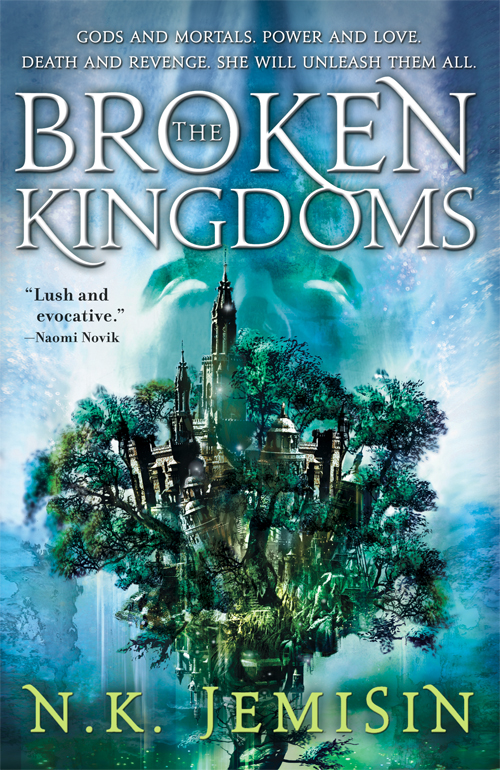
The Broken Kingdoms, the second book in N.K. Jemisin's Inheritance Trilogy, is, simply put, wonderful. Jemisin has crafted an intelligent, entertaining and, ultimately, heartbreaking sequel to The Hundred Thousand Kingdoms.

It begins ten years after the events in The Hundred Thousand Kingdoms. The Arameri family still rules the palace of Sky and all of the hundred thousand kingdoms of the world; however, a giant tree grows through the middle of the palace, and the city that hus sprung up at the foot of the Tree is called Shadow. Bright Itempas - once the only god worshipped of the Three - must contend with the worship of other gods, particularly two new ones, the Lord of Shadows and the Gray Lady. It is a time of change in the world.

Oree Shoth, a blind artist with a gift for painting who sells her trinkets and baubles in a market in Shadow, one day finds what appears to be a godling - one of the many children of the Three - in a muckbin. Oree has two gifts, really: painting, and the gift of sight through use of magic. She can follow godling footsteps, make outlines of them in the darkness of her world - when magic is used around her, Oree can see. Here is how Jemisin describes Oree seeing the godling, whom she's nicknamed "Shiny", one morning: "...he turned his gaze outward again, his hair and shoulders beginning to shimmer. Next I saw his arms, as muscled as any soldier's, folded across his chest. His long legs, braced slightly apart; his posture relaxed, yet proud. Dignified. I had noticed from the first that he carried himself like a king."

Shiny does not speak  - not at first. Oree and he carry on a muted existence with Shiny constantly unaware of the dangers of his mortal-like body. Oree must clean up the blood of one of his fatal accidents more than once, but always, Shiny resurrects, emotionless and distant to his surroundings. It is not until Oree finds a godling murdered - a thing thought impossible - in an alley near her market that Shiny shows any outward sign of emotion. From here, The Broken Kingdoms spirals into the world of Shadow: against heretical and non-heretical priests of the Order of Itempas, down through godlings (one of whom was once Oree's lover), into the palace of Sky where Oree is burdened with a heavy revelation about herself, into darkness where one of the weirdest conglamarations of a demon ever written awaits.

It is the relationship between Shiny and Oree, however, that is at the heart of The Broken Kingdoms: how Shiny's disdain for mortalkind becomes begrudging respect and then, perhaps, something more; how Oree's initial dislike of Shiny's carelessness with his own body and his arrogance changes as she changes, discovering more about herself and the mystery of who and what Shiny really is. Jemisin seems very interested in understanding the differences and similarities of love and hate, and where the two collide.

There is also a lot of action in The Broken Kingdoms, yet Jemisin retains a meditative-like tone throughout. Her prose is clean and cool and, though she is working on a large canvas, her world-building rings true and nothing is unclear by novel's end. The voice of the story, however, really belongs to Oree. She is a strong, sympathetic character and Jemisin endears her to us. Though blind, she sees more than a person with perfect sight; yet, she is also flawed, blind to her own past. The aforementioned "heavy revelation" only adds to her complicated, interesting personality.

It's often said that the middle book of a trilogy is the least cohesive, it having to tie up loose ends from the first book while also threading new plot twists to be tied up in the concluding book. Jemisin avoids these pitfalls by letting the books stand alone, though reading them in order (her third, The Kingdom of Gods is due out later this year from Orbit) one can see her deft world-building and carry-over threads working gloriously. Recommended.

(Also recommended, The Hundred Thousand Kingdoms, the first book in the Inheritance Trilogy.)

-Dustin Monk

Wednesday, April 27, 2011

seasecrets!fossils!fictions!

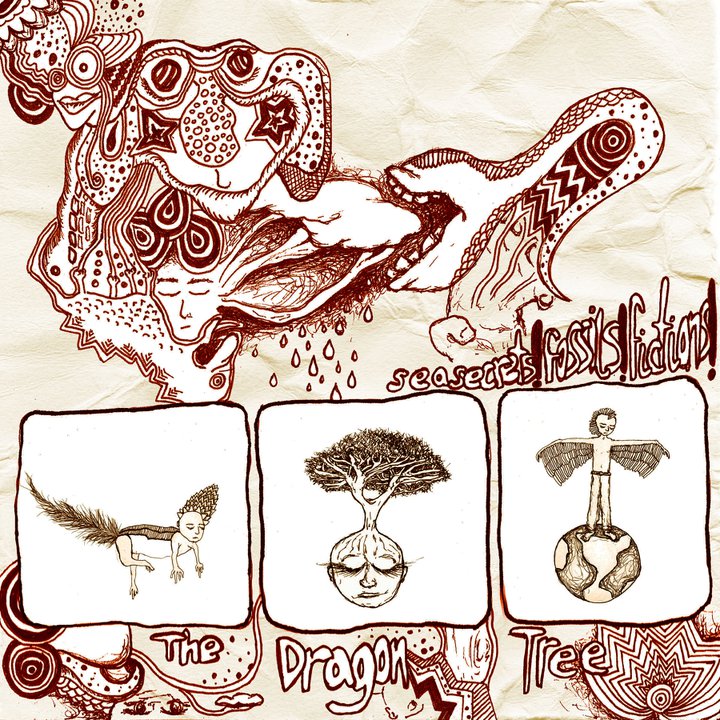
For those of what haven't been watching facebook the past few days, my sister's EP, seasecrets!fossils!fictions!: the dragon tree, is available now from her bandcamp page. That link will take you there where you can download the record for free right now. Pretty soon, it will be available at Prospero Records, if you'd like a hard copy.

Mandy recorded this in her garden apartment with Justin Turner, Lindsay Southern, and myself. A couple of things about this record: these are Mandy's finest songs to date (and she had some excellent songs in our former band, Root Shoot Leaf); "Backyard" has my favorite bassline that I've written for a song; though the dragon tree is only 5 songs, the songs flow together seamlessly, and even tell a story of sorts.

In Root Shoot Leaf, Mandy and I collaborated on a lot of songs and a lot of records in a short period of time (something like 5 full-lengths and 3 EPs in 4 years), but this is Mandy's first release since Root Shoot Leaf's demise in 2008. It was worth the wait.

Above and below is the awesome artwork (also by Mandy) for the record. Enjoy.


Tuesday, April 26, 2011

10 Records That Shaped My Youth: End of Days

There's no way to tell what records I'm listening to right now I'll be listening to in ten years, or five years, or two. But, as far as it goes, here are ten records that have really shaped my musical experience over the last two years.

1. Real Estate - Real Estate
I was talking to Dave from the Nothingheads last night about this band. We both agreed that Real Estate relaxes the listener. So many gorgeous guitar riffs.

2. Woods - Songs of Shame
"To Clean," the first track on Songs of Shame, reminded me of my old band, Root Shoot Leaf, so much that I had to hear the rest of the record. I'm glad I did. It's a lo-fi jam classic. Supposedly, their follow-up, At Echo Lake, is even better, but I have yet to hear it. Anyway, what's not to love about messy songs and falsetto voices?

3. Panda Bear - Person Pitch
It took me a long time - A. Long. Time. - to get into this record. I've always loved Noah Lennox's melodies, but this record is 50+ minutes of repetition and samples. Of course, that isn't true - deeper listenings reveal  a lot of really cool stuff happening in these songs. It also works greatly as a record to just sort of get lost in.

4. Bill Callahan - Sometimes I Wish We Were An Eagle
God, I love Bill Callahan. Listen to that crooning bass; he's almost never faster than mid-tempo and, you know what? I'm okay with that. When he sings, "If I could only stop my heart beat for one heart beat," staggering the words out over two minutes, I'm there with him, all the way.

5. Radiohead - In Rainbows
A casual reader might've noticed the lack of Radiohead as youthshaper. Well, let me say that I liked Radiohead. Kid A almost made the list from ages 21-25 (it's also the only CD I've never pawned for beer money, so that must mean something, right?), but I just never listened to it. Sadly, Ok Computer was released during my Beatles-only phase and, though I owned it and had listened to it a few times, well, all I can say is: it wasn't the Beatles, man! Now, In Rainbows is the record that got me back into Radiohead. Over the course of its ten songs, I run the gambit of emoto-meter. I am spent by the time Thom Yorke sings, "Today has been the most perfect day I've ever seen."

6. TV on the Radio - Dear Science
Each consecutive TVOTR release I've loved more than the last. This is a band, as my friend Leah pointed out, that stays consistent. You can always count on Tunde Adebimpe and Kyp Malone and David Sitek for some seriously good songs. Dear Science is the peak of this band and what a peak it was. This is another of those "perfect" records. It seethes with life and energy and enthusiasm.

7. Kurt Vile - Childish Prodigy
I've been saying for awhile now that Kurt Vile is one of the last, great true songwriters. His lyrics are ethereal and weird; they float around the edges of the songs, almost never landing. But when they do land it's with the power of a oncoming train. "Flopping and flipping around like a fish on a ship!" Vile screams. Damn straight.

8. Deerhunter - Microcastle
There's a lot to love and a lot to hate about Bradford Cox, lead singer and songwriter of Deerhunter. His musical output is staggering, sometimes releasing a song a day on his blog. Some of those songs, however, are pure garbage - Cox doesn't care, he just loves making music. Microcastle is Deerhunter on a good day. It's honest, it's dark, it's cool, it's weird, it's fun, it's heartbreaking.

9. Distractions - Dark Green Sea
Distractions are a local Chicago band fronted by one-time keyboardist for Tin Tin Can, Tom Owens. Owens might be the epitome of everything I currently love about music. Here is his low baritone, there is the washed-out vocals, here are beautiful major seventh chords, there are frequent meter changes, here is that vintage organ sound, oooh, and there is some tremolo. There's no losing when it comes to listening to Distractions.

10. Jens Lekman - Night Falls Over Kortedala
I actually started listening to and loving Jens Lekman in 2007. Oh You're So Silent, Jens - compilation of songs he'd released in his native Sweden - caught my attention, so that when I heard he had a new record coming out, I bought it immediately, and fell deeper in love with this crooning heartthrob. I'll be honest, it probably should've made the list last week, but I still listen to this record almost weekly, so it counts now if it counts anywhere.

Honorable Mentions (over the entirety of this series):

MC Hammer - 2 Legit 2 Quit
Radiohead - Ok Computer/Kid A
Fleet Foxes - Fleet Foxes
Sigur Ros - ()
Modest Mouse - Good News for People Who Love Bad News
Okkervil River - The Stage Names/The Stand-ins
Paul Simon - Graceland
The Kinks - Arthur
The Streets - A Grand Don't Come for Free
Van Morrison - Astral Weeks
Beat Happening - You Turn Me On
My Bloody Valentine - Loveless
James Blak - James Blake

I'll leave you with a question and an answer. What's your favorite record, right now? Mine is Cass McComb's Wit's End.

Monday, April 25, 2011

Review: The Dragon's Path by Daniel Abraham

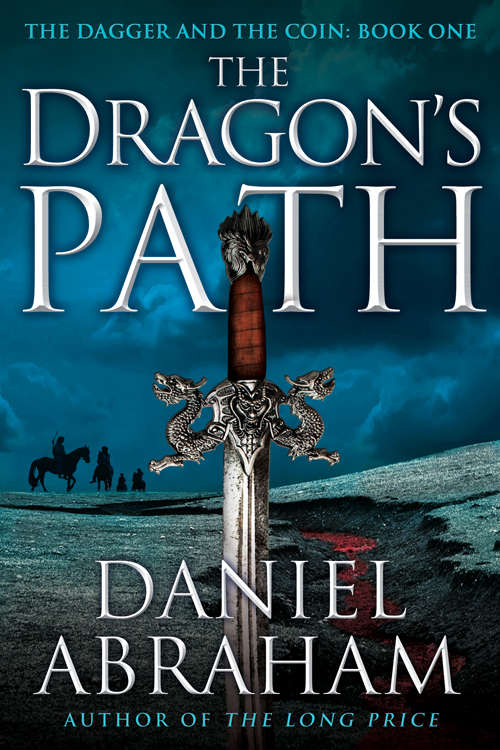
The first book in Daniel Abraham's new fantasy series, The Dagger and the Coin, does not turn tropes on their heads or reinvent the genre; instead, what Abraham is concerned with is engaging fantasy - including its strengths and weaknesses - on its own terms. Indeed, in the "Extras" section at the end of The Dragon's Path, Abraham discusses having "permission to be part of a greater body of literature." Where his first fantasy series, the critically acclaimed and excellent Long Price Quartet, gave readers an interesting and new take on magic and placed it outside the traditional Medieval European setting, The Dragon's Path travels the rutted road of many epic fantastists - yet, it has all of Abraham's charm and wit, making The Dragon's Path an entertaining and engaging read.

Part of what Abraham does so well is write compelling characters. This is epic fantasy, to be sure, but the important players in The Dragon's Path are not great warriors or sorcerers or sorceresses (though, each of these certainly make appearances). There is Cithrin, an orphan and ward of the Medean Bank, who must smuggle the free city of Vanai's wealth across the countryside after her city is sacked. And Geder Palliako, the "lone scion of a noble house" who is more interested in speculative essays than swordplay, and is constantly made fun of for it. Marcus Wester is the closest Abraham gets to a great warrior; however, Marcus's glory days (tinged with tragedy though they are) are well behind him and he has become a mercenary and caravan guard. Dawson Kalliam, childhood friend of the king of Antea, is a man of tradition, whether right or wrong, and will do anything to keep the kingdom from falling. His wife, Clara, also plays into the action near the end of the novel - she is certainly more intelligent than Dawson and has a better grasp of court politics and the great changes sweeping through the kingdom.

The most interesting characters in The Dragon's Path are Cithrin and Geder, however, because their actions, at the best times, are morally ambiguous, deeply affecting, and, most important, truly human. When Geder is forced into a position of power, his conclusion of Vanai sets in motion various other power plays in the kingdom of Antea, where Geder hails from, and eventually sets him out on a journey unlike anything he's known. As dangers coalesce around Cithrin, her decision concerning the wealth of Vanai will potentially make her a very powerful woman - as war hits the continent, many nations may depend on loans from her branch. Both Geder and Cithrin make good and bad choices. Geder's naivete and near-sociopathic tendenies will have you cursing him at some points in the book; yet, in the end, you want Geder to win or, at least, do something right. Cithrin, too, is a complex character: her growth from a frightened girl in a world of unknowns to a confident banker is marvelous, though she is still fueled by the folly of youth.

The world Abraham's built is based around the end of the reign of dragons and the creation of the thirteen races of man. He spends most of the novel with the Firstbloods, glossing over the other twelve races with superficial detail - "tall-eared Tralgu, chitinous Timzinae, tusked Yemmu...The Dartinae had small braziers in their eyeholes...a Kurtadam with clicking beads." If there is a weakness in The Dragon's Path, it's here; however, this being the first book in a series of an expected five, it's possible Abraham well get more in depth with these races as they become important to the tale. Part of the first book in a series of this magnitude is setting up the world, letting the reader know the rules, and Abraham succeeds in that.

Beyond the political intrigues and banking contracts, Abraham has constructed an interesting if familiar back story concerning the age of dragons (who are now extinct, but left jade roads called "dragon roads" in their wake), and a temple of priests who can tell whether or not a person is lying and are concerned with the End of All Doubt and a very nasty spider. The revelation of the "End of All Doubt" is Abraham's intriguing spin on the "looming darkness" or "freeing of the great evil lord" common to commercial epic fantasy; it'll be exciting where he leads us.

Though The Dragon's Path shares similarities with past epic fantasy series', Abraham knows his strengths as a writer and, what might come off as cliche in a lesser writer's pen, here reads excitingly fresh. Recommended.


-Dustin Monk

Thursday, April 21, 2011

News of the Day: Recording Update

After a break in recording to work on new songs, Tin Tin Can is ready to go at it again. We're setting up dates to record in Detroit with our friend Mark. We recorded initial tracking for our previous EP, The Devil & the Mockingbird, with Mark and it was so much fun we wanted to do it again. We're very excited to be recording on analog tape, too!

We've got a batch of songs - some of which we've played at recent shows, some that we haven't - that we feel really good about and hope you do too. I don't have any specific dates for release of the record yet, but we're definitely looking at late summer.

Here are a few of the songs we'll be recording with Mark. These are working titles, though, and not in any particular order.


1. Wrecking Ball
2. Friends & Family
3. City Lights
4. What Fireworks
5. Abducted by Aliens

In the meantime, you can get by with the new Nothingheads EP as well as my sister's project, seasecrets!fossils!fictions, which will be released very soon.

Tuesday, April 19, 2011

10 Records That Shaped My Youth: Ages 26-29

I lied. It doesn't get that weird. It actually gets a little hipster-ish. I'm not sorry. I still love all of this music. In fact, we're coming to an end (only one more post left in this series), so most of the music contained in this post I still listen to, sometimes on a daily basis. I've also decided that I don't know when "youth" ends which is why it's gone this far. Is 29 still young? Sure, why not.

1. Neutral Milk Hotel - In the Aeroplane Over the Sea
Like Weezer's Pinkerton, Neutral Milk Hotel's second record is a masterpiece, as near to perfect as a series of songs placed in just such an order gets. That Jeff Mangum, singer/songwriter of NMH, has released almost nothing new since this record has only increased Aeroplane's mysteriousness and wonder.

2. Sufjan Stevens - Illinois
It's long, it's fluffy, it's bloated, it's totally over the top in every possible way, it's full of enthusiasm and heart, horns, choirs, xylophones, trills, gorgeous melodies, polyphony, weirdness, pretty much everything. What's not to like?

3. Xiu Xiu - La Foret
Where the above Sufjan record is everything everywhere all of the time, Xiu Xiu's La Foret is a study in understatement and silence. Here, Jamie Stewar barely rises above whisper when singing though the songs do at times "rock" - in the totally avant garde way Xiu Xiu rocks out. I saw Jamie Stewart and his band perform at Intonation Fest in '05 (now it's called Pitchfork Festival, heh) and was blown away by their live performance. Stewart believes every weird thing he says.

4 & 5 & 6. Animal Collective - Feels/Strawberry Jam/Merriweather Post Pavilion
My friend Leo introduced me to Animal Collective. He and I met via myspace (remember myspace?) and a mutual respect of each other's music. (Later one, we'd both be members of each other's bands, but that's another story.) Of course, there was a lot of overlap in music that we listened to, but every now and again, we came across something that one of us hadn't heard (for instance, I introduced Leo to Xiu Xiu). "Grass" was the first song that I loved by Animal Collective and I think I listened to Feel in its entirety every single day while working for the Jewish United Fund. Strawberry Jam is a cold and distant record, closer to a snowy gray day than anything else, but I listened to it over the summer and so when I hear songs like "Fireworks" or "For Reverend Green" I am reminded of the tall grasses of Carbondale and drunkenly playing video games in Andy's trailer. Merriweather Post Pavilion is a Chicago night record, for me. It's all about sweating beer in the practice space, our only light a string of christmas lights, a cigarette butt-filled floor, and the Green Line.

7. Bob Dylan - Highway 61 Revisited
In 2007 I recorded Dustin Monk & the Dirty Priests which, in its weird way, was in response to Highway 61 Revisited. I wanted to do something as lyrically psychedelic as "Desolation Row" and as rolling as the title track. I don't know that I succeeded but it was a fun experiment and led me to a deeper understanding of the awesomeness that is Dylan.

8. Bruce Springsteen - Darkness at the Edge of Town
Around the same time that I was rediscovering Dylan, I was also discovering (for the first time) the Boss. Born to Run is certainly a great record, though I find fault with three of its eight tracks and therefore couldn't include it here. Instead, I give you Darkness - ten songs of pure 70s rock, perfect and implacable. From start to finish, Darkness is absolutely the most blustery, dark, and hot summer night you have ever experienced.

9. The Hold Steady - Boys & Girls in America
In keeping with the theme of bar rock awesome, The Hold Steady's Boys & Girls in America really hit me. Craig Finn's lyrics, the guitar riffs, the anthemic, ahem, fist-pumping. Whatever they've become now (Jimmy Eat World wannabes?), this record and its predecessor, Separation Sunday, are great retro rock records full of the kind of hyper-literary lyrics I'm apparently so fond of.

10. Of Montreal - Hissing Fauna, Are You the Destroyer?
Of Montreal, in my opinion, is really really really hit or miss. Their earlier records sound like weird Beatles stuff. The stuff Kevin Barnes is doing now is funky and, yeah, weird, and not that good. But he had a moment. Hissing Fauna is, like Pinkerton and Aeroplane, perfect from start to finish. By the time you get to the eleven minute opus, "The Past is a Grotesque Animal," you are in; and, if you're not in by then, you never will be. Get it?

So. Hipster Beach Boys, bar rock, avant garde, stream-of-consciousness folkrock? I guess that pretty much summed me up from 2006-2009. Next week: where do we go from here.

Saturday, April 16, 2011

Review: The Enterprise of Death by Jesse Bullington

For readers expecting more gruesomeness, grotesquerie, and vulgarity from the author of The Sad Tale of the Brothers Grossbart, Jesse Bullington's second novel, The Enterprise of Death, will not disappoint. Cannibalism, necrophilia, venereal diseases, the walking dead (sometimes all at once!): Enterprise has these - and more! - in spades. "Pity Boabdil," Enterprise begins, and pity the reader with a weak stomach, for Bullington is a master at gritty, harrowing and awe-inspiringly macabre detail.

Enterprise follows Awa - lesbian African slave and reluctant necromancer - on her strange journey to find the book that may (or may not) break the curse her master put upon her through a Europe in the midst of the Spanish Inquisition. Along the way Awa encounters fictional and nonfictional characters alike - from the pistol-toting mercenary Monique to the real-life Reformationist and artist, Niklaus Manuel of Bern. Some of these people help her, others seek to destroy her and name her for what she is; throughout, however, is Awa's perserving spirit.

If Enterprise's humor is sometimes darker and smattered less generously than its predecessor, it's because, at is heart, Enterprise is a more serious and deeper investigation into our humanity. Bullington isn't afraid to tackle questions of morality, particularly whether the performance of necromancy is good or evil, because Awa - for all that she is a witch and raises the dead with or without their permission - is trying to live the best possible life a black homosexual woman with supernatural powers can live during the Inquisition.

Bullington utilizes his writing strengths - clever, gritty prose and witty asides - much as he did in his debut. The difference is, instead of the heretical graverobbing murdering bastards at the heart of Grossbart, Enterprise has characters - despite their many sins - you can root for. Manuel and Monique, and especially Awa, all strive for genuine goodness. But, as Awa surmises, "The problem with telling tales about real people [is] no summary can convey every truth, every facet, and what is good for the hare is not good for the fox."

Enterprise skillfully continues the macabre niche Bullington is carving out for himself, but also brings something new to his table.

-Dustin J Monk